


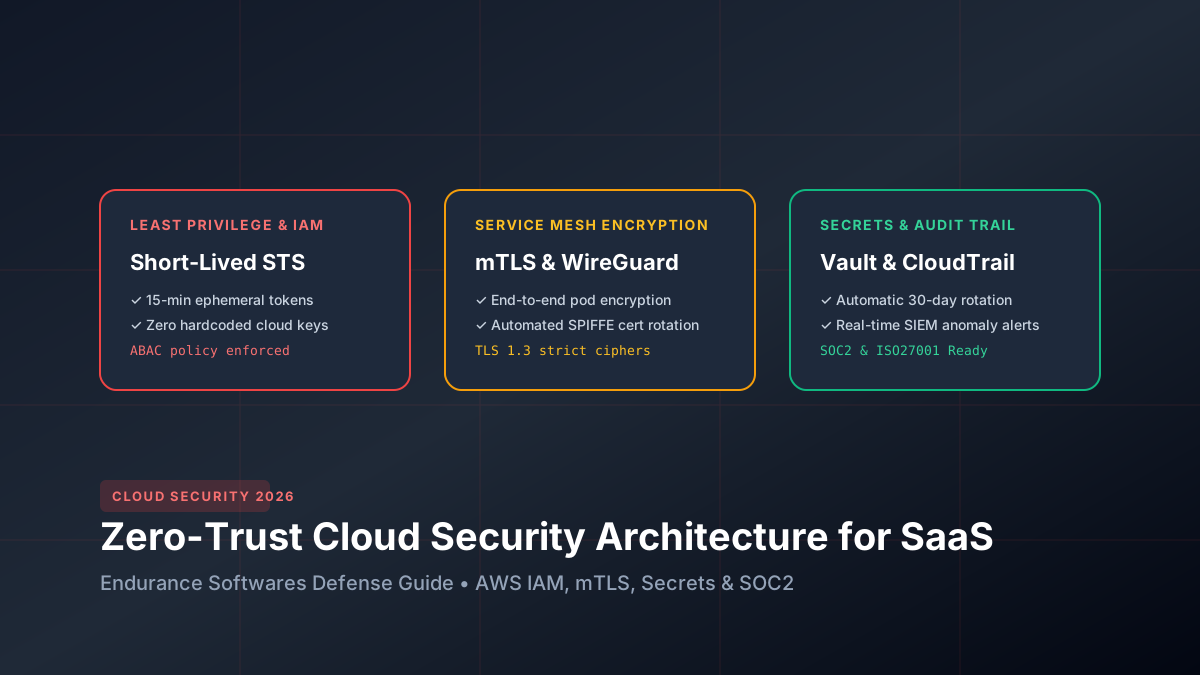
Zero-trust cloud infrastructure eliminates permanent API keys, static database passwords, and open internal VPC networks. By provisioning 15-minute ephemeral STS tokens, enforcing mutual TLS (mTLS) across microservice meshes, and logging tamper-proof cryptographic audit trails, companies safeguard sensitive enterprise customer data against insider threats and credential leaks.
The 5 Core Tenets of Zero-Trust for SaaS
| Pillar | Vulnerable Legacy Approach | Zero-Trust Production Implementation |
|---|---|---|
| Identity & IAM | Long-lived static AWS access keys in .env | Ephemeral short-lived STS tokens with ABAC session tags |
| Network Mesh | Flat internal VPC with unencrypted HTTP | Strict mTLS via Istio / Linkerd with SPIFFE identity |
| Data at Rest | Shared database encryption key | Per-tenant customer-managed KMS keys with envelope encryption |
| Secret Lifecycle | Static config files updated every 6 months | Automated 30-day dynamic secret generation via HashiCorp Vault |
| Audit & Detection | Ad-hoc server log grep | Real-time streaming CloudTrail into Datadog SIEM with anomaly alerts |
Minting Ephemeral IAM Credentials with AWS STS
Never grant broad permissions to application compute containers. Use Attribute-Based Access Control (ABAC) and AWS Security Token Service (STS) to mint short-lived session tokens tagged specifically for the calling tenant:
// sts-assume-role.ts - Ephemeral Zero-Trust Credential Minting
import { STSClient, AssumeRoleCommand } from "@aws-sdk/client-sts";

const stsClient = new STSClient({ region: "us-east-1" });

export async function getEphemeralServiceCredentials({
  tenantId,
  serviceName,
  durationSeconds = 900, // 15-minute maximum lifecycle
}) {
  const command = new AssumeRoleCommand({
    RoleArn: "arn:aws:iam::123456789012:role/SaaSTenantWorkerExecutionRole",
    RoleSessionName: `tenant-${tenantId}-${serviceName}-${Date.now()}`,
    DurationSeconds: durationSeconds,
    Tags: [
      { Key: "TenantId", Value: tenantId },
      { Key: "Environment", Value: "production" },
      { Key: "Initiator", Value: serviceName },
    ],
  });

  const response = await stsClient.send(command);

  return {
    accessKeyId: response.Credentials?.AccessKeyId,
    secretAccessKey: response.Credentials?.SecretAccessKey,
    sessionToken: response.Credentials?.SessionToken,
    expiration: response.Credentials?.Expiration,
  };
}
Mutual TLS (mTLS) Across Microservices
Even inside an Amazon EKS or Kubernetes cluster, network traffic can be intercepted if a single container is compromised. A service mesh (such as Linkerd or Istio) automatically injects sidecar proxies that establish hardware-accelerated mutual TLS (TLS 1.3) with rotating X.509 certificates between all service pods.
Dynamic Secrets Management & Auto-Rotation
Static database passwords are the #1 attack vector in cloud breaches. Configure HashiCorp Vault or AWS Secrets Manager with automated Lambda rotators. PostgreSQL user credentials should be generated dynamically with a 24-hour time-to-live, ensuring compromised passwords expire automatically.
Tamper-Proof Audit Logging & Anomaly Detection
Ship structured JSON logs to write-once-read-many (WORM) S3 buckets with Object Lock enabled. Configure real-time automated detectors for privilege escalation, unexpected geographic IP spikes, and mass database export attempts.
Zero-Trust Security Checklist
✓ Zero static AWS access keys stored in source repositories or .env
✓ AWS IAM roles assume short-lived STS tokens with < 15 min TTL
✓ Mutual TLS (mTLS) enforced across all internal Kubernetes pods
✓ Secrets stored in AWS Secrets Manager / Vault with automated rotation
✓ S3 buckets encrypted with customer KMS keys & public access blocked
✓ Multi-Factor Authentication (FIDO2 WebAuthn) enforced on admin portals
✓ Immutable audit trails shipped to WORM compliant cloud storage
✓ Automated vulnerability scanning (Trivy / Snyk) active in CI/CD
Harden Your Cloud Infrastructure with Endurance Softwares
We help SaaS startups and enterprises achieve SOC2 compliance, implement zero-trust cloud architectures, and pass rigorous enterprise security reviews.
Request a Cloud Security AssessmentFrequently Asked Questions
How does zero-trust impact application latency?
Modern TLS 1.3 session resumption and hardware AES-NI instructions introduce less than 0.2ms of overhead, making zero-trust encryption imperceptible to end users while delivering airtight defense.
Is zero-trust required for SOC2 Type II certification?
While SOC2 does not explicitly use the term "zero-trust", its core Trust Services Criteria (least privilege, encrypted transit, access review, and credential rotation) map directly to zero-trust principles.
How do we manage secrets across local dev and cloud environments?
Use tools like Doppler or 1Password Developer CLI to inject encrypted secrets at runtime into local processes, preventing plain-text secret storage on developer laptops.