


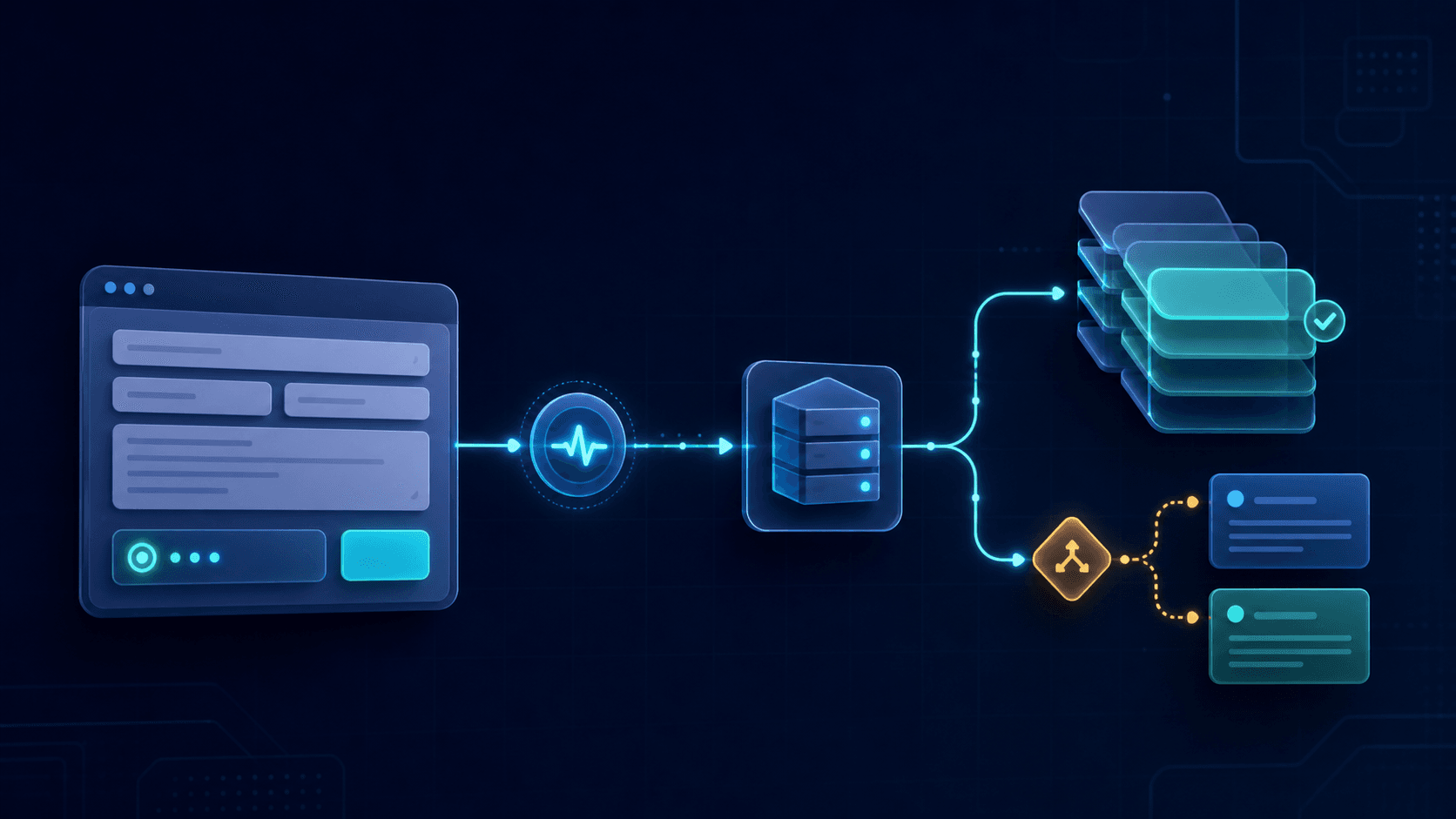
Start with a save-state contract
A vague spinner is not enough. A person needs to know whether their last edit is local, being sent, safely stored, or needs attention. Model that state explicitly and keep the status close to the form rather than hiding it in a global toast.
Editing
The form differs from the last acknowledged version. Nothing has been promised to the server yet.
Saving
A specific revision is in flight. New keystrokes may already belong to a later revision.
Saved or blocked
Show a timestamp after success; show a clear recovery action after failure or a conflict.
Keep the server-acknowledged snapshot separate from the current inputs. That distinction prevents a slow response from incorrectly marking newer changes as saved. The same ownership discipline helps avoid stale UI in our React async data fetching guide.
Debounce typing, serialize writes, and acknowledge revisions
Debouncing reduces needless requests, but it does not make writes safe by itself. Send a monotonically increasing revision or an idempotency key with each snapshot. Either serialize saves or ignore acknowledgements for older revisions; otherwise a slow first request can overwrite a later edit.
const revision = useRef(0);
const savedRevision = useRef(0);

const scheduleSave = useMemo(
  () => debounce(async (nextValues) => {
    const currentRevision = ++revision.current;
    setSaveState("saving");
    const result = await fetch("/api/profile", {
      method: "PUT",
      headers: { "Content-Type": "application/json" },
      body: JSON.stringify({ values: nextValues, revision: currentRevision }),
    });
    if (!result.ok) throw new Error("Save failed");
    if (currentRevision >= savedRevision.current) {
      savedRevision.current = currentRevision;
      setSaveState("saved");
    }
  }, 600),
  []
);
In a real implementation, cancel the debounced callback on unmount, handle aborted requests, and choose whether the server rejects stale revisions or simply stores the newest one. For writes that users may retry after a flaky connection, use the durable request identity described in our Node.js idempotency keys guide.
Validate continuously for guidance, decisively on save
Client validation should help a person complete the form: show field-level guidance after meaningful interaction, avoid announcing every keystroke as an error, and do not silently discard an invalid draft. Server validation is the authority because browser rules can be bypassed and the accepted schema can change between sessions.
Separate three outcomes in your API: a valid saved revision, a validation response that points to fields the person can fix, and an unexpected failure that preserves the local draft. Return structured field errors rather than a generic “bad request,” but never trust client-supplied permissions or ownership fields.
Use local drafts as a recovery layer, not a second source of truth
Persist a small, scoped draft locally after input changes so a refresh, crash, or short outage does not erase work. Include the record ID, schema version, user scope, updated time, and the server version it was based on. Do not store passwords, payment fields, access tokens, or sensitive data in browser storage.
When the page opens, compare the local draft with the server snapshot. If the draft is newer and compatible, offer to restore it; if it is already acknowledged, remove it. Expire abandoned drafts and clear them after a confirmed save. This makes recovery predictable without quietly reviving obsolete information.
Make concurrent edits explicit
Autosave cannot guess which edit wins when two people change the same record. Send a version number or ETag with each mutation. If the server sees an older base version, return a conflict response with the current canonical record instead of applying a blind overwrite.
Field-level merge
Useful when fields are independent and each change has clear ownership.
Choose a version
Best for short documents where a person can compare local and remote values.
Domain workflow
Required for irreversible or regulated actions; do not rely on “last write wins.”
Conflict handling belongs in the product design. For an address form, merging separate fields may be reasonable; for a price, policy, or approval, require an explicit review. Protect the mutation boundary with the same authorization and validation practices in our Next.js Server Actions security guide.
Announce save feedback without interrupting the task
Use a persistent visual status plus a polite aria-live region for meaningful changes such as “Saving draft,” “Saved at 10:42,” or “Could not save—retry.” Do not move focus when a background save succeeds. If an error needs action, preserve the user’s inputs, identify the affected field or form area, and make the recovery control keyboard reachable.
Test the flow with a keyboard, a screen reader, reduced-motion preferences, slow network simulation, and an offline transition. The goal is calm feedback: enough signal to build trust, never enough noise to break typing.
Measure the reliability users actually experience
Track save attempts, latency, success rate, validation failures, conflict rate, retries, restore prompts, and abandoned unsaved drafts. Segment by route, release, browser, and network quality. Avoid collecting raw form values in telemetry; event metadata should be sufficient to expose a broken save path.
Alert on a sustained increase in failed saves or conflict responses, then use request IDs to follow a specific save through the browser, API, and storage layer. Our Next.js observability guide shows how to make those traces useful during an incident.
React autosave production checklist
✓ Current inputs and acknowledged server data are separate
✓ Save state clearly distinguishes editing, saving, saved, and blocked
✓ Writes use revisions, versions, or idempotency keys
✓ Slow responses cannot overwrite newer edits
✓ Server validation and authorization remain authoritative
✓ Local recovery drafts are scoped, expired, and safe to store
✓ Conflicts return a recovery path instead of silent overwrites
✓ Status feedback works with keyboard and screen readers
✓ Telemetry measures save outcomes without recording form contents
Build React forms people can trust
Endurance Softwares helps teams ship dependable React and Next.js experiences, from resilient form flows and safe APIs to observability and production readiness.