


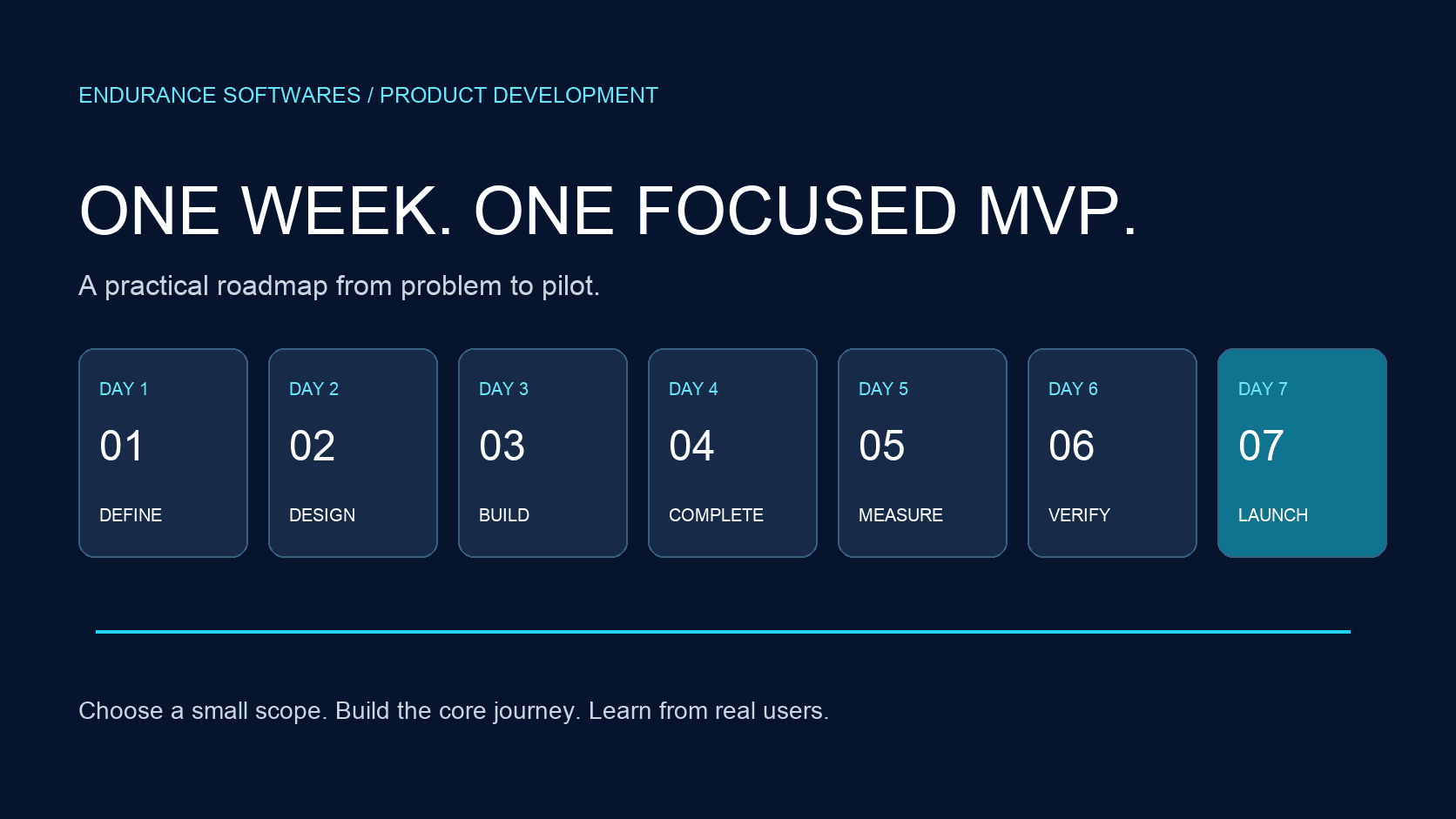
What can you build in one week?
A one-week MVP is a small, usable product that tests one business assumption with real users. The goal is to learn whether a specific audience gets enough value from one workflow to return, pay, or commit to a next step. A seven-day schedule is a planning constraint, not a guarantee that every product can launch safely in that time.
A focused appointment request tool, client intake portal, or simple internal approval flow can fit this approach when the team already understands the problem. A complex marketplace, regulated workflow, or product with several unproven integrations usually needs a narrower pilot or a longer discovery phase.
Before choosing a build, understand the distinction between an MVP, a prototype, and a production product. If the main uncertainty is usability, a prototype may answer the question before you invest in working software.
Day 1: Pick one user, one problem, and one outcome
Write a short brief with the target user, the task they struggle with, and the observable result your MVP should deliver. Speak with prospective users or review existing customer evidence. Identify how they solve the problem today and what would make switching worthwhile.
- Choose one primary journey, such as submitting and confirming a booking request.
- Define an activation event: a real client submits a request that the consultant can act on.
- Recruit a small pilot group before launch day.
- Agree on a decision rule, such as reviewing five pilot attempts and interviewing each participant.
Deliverable: A one-page brief, a must-have list, and a deferred-feature list. Keep payment automation, calendar synchronization, advanced reports, and multiple user roles out of this example unless they are essential to testing the hypothesis.
Day 2: Map the shortest complete journey
Sketch the screens and states needed to finish the task: booking page, request form, submission result, and a protected request inbox. Include validation errors, empty states, unavailable times, and what happens when a user submits twice.
Walk a prospective user through the flow before implementation. If they cannot explain what happens after submitting, improve the copy and sequence now. Decide which work will happen manually: the consultant can approve requests by hand while the product records status and communicates the next step honestly.
Deliverable: An agreed screen flow and acceptance criteria. For example: a valid request is saved once, appears only in the correct consultant inbox, and shows the client a clear pending status.
Day 3: Build one working path from start to finish
Use a stack the team already knows and a deployment process it can maintain. Set up the application, data model, environment configuration, and a private preview. Implement one thin path from form submission to persistent storage to the consultant inbox.
Keep the architecture simple enough for the pilot. Protect private views, validate submissions on the server, and keep secrets out of browser code. Avoid spending this day on reusable frameworks, elaborate dashboards, or infrastructure for demand you have not observed.
Deliverable: A preview where one representative request can complete the entire journey with realistic test data.
Day 4: Finish the core workflow and its failure states
Add the remaining behavior required for the pilot: status changes, useful confirmation copy, and a reliable way for the consultant to notice new requests. Make the difference between a pending request and a confirmed appointment explicit.
Check duplicate submissions, missing fields, expired sessions, and failed saves. Preserve user input when a recoverable error occurs. If an external integration is essential, verify its failure behavior now; if it cannot be made dependable within the week, reduce the scope and explain the manual process to pilot users.
Deliverable: The agreed core journey works, and common failures leave users with a clear next action.
Day 5: Add measurement and a feedback loop
Record a small set of events that answer the original question: journey started, request submitted, consultant responded, and user returned. Define each event precisely so repeated clicks or internal tests do not look like new customers.
Use a support address or short feedback form and schedule pilot interviews. Ask what users expected, where they hesitated, and whether the result helped them finish their task. Collect only the data needed for the pilot and explain its use. Avoid putting personal form contents into analytics or error logs.
Deliverable: A simple view of activation and completion, a way to investigate failures, and a feedback channel with a named owner.
Day 6: Test the release you intend to launch
Run the complete journey on mobile and desktop with someone who did not build it. Check keyboard navigation, labels, focus visibility, loading feedback, and error recovery. Verify that one user cannot read or modify another user's requests by changing a URL or request identifier.
- Test successful submission, invalid input, duplicate actions, and a failed network request.
- Confirm production configuration, notification destinations, and any sandbox settings.
- Verify backups and a practical recovery or rollback procedure.
- Remove test data and check that logs contain no secrets or unnecessary personal data.
- Assign someone to watch errors and answer pilot support requests.
Deliverable: A release candidate with no known blocker in the core journey. If access control, data integrity, or recovery remains unresolved, extend the schedule or launch a smaller pilot.
Day 7: Launch to a small group and observe
Invite the recruited pilot users and watch them attempt the primary task. Keep the group small enough to support directly. Record where people stop, what requires help, and whether they reach the outcome defined on day one.
Separate product confusion from technical failures. Fix a broken submission quickly, but do not add every requested feature immediately. Ask which missing capability prevents the user from receiving value and whether a manual step can resolve it during the pilot.
Deliverable: A live pilot, a short issue list, and scheduled follow-up conversations. Launch starts the learning period; it does not prove demand by itself.
Decide what to build after the first week
Review behavior and interviews against the original decision rule. If users complete the task and want to repeat it, improve reliability and remove the most expensive manual step. If they need repeated assistance, refine the journey. If the outcome does not matter to them, revisit the problem before adding features.
Continue
Users get value and return. Invest in the bottleneck that limits repeat use.
Refine
The need is real, but the workflow is confusing. Test a smaller change.
Reconsider
Users do not value the result. Revisit the audience or hypothesis.
The useful result of one-week MVP development is working software paired with evidence for the next decision. Keep the scope small, make the core experience dependable, and let user behavior guide the second week.
Plan your first MVP release
Endurance Softwares can help you define a focused MVP, build the core workflow, and prepare a pilot launch.