


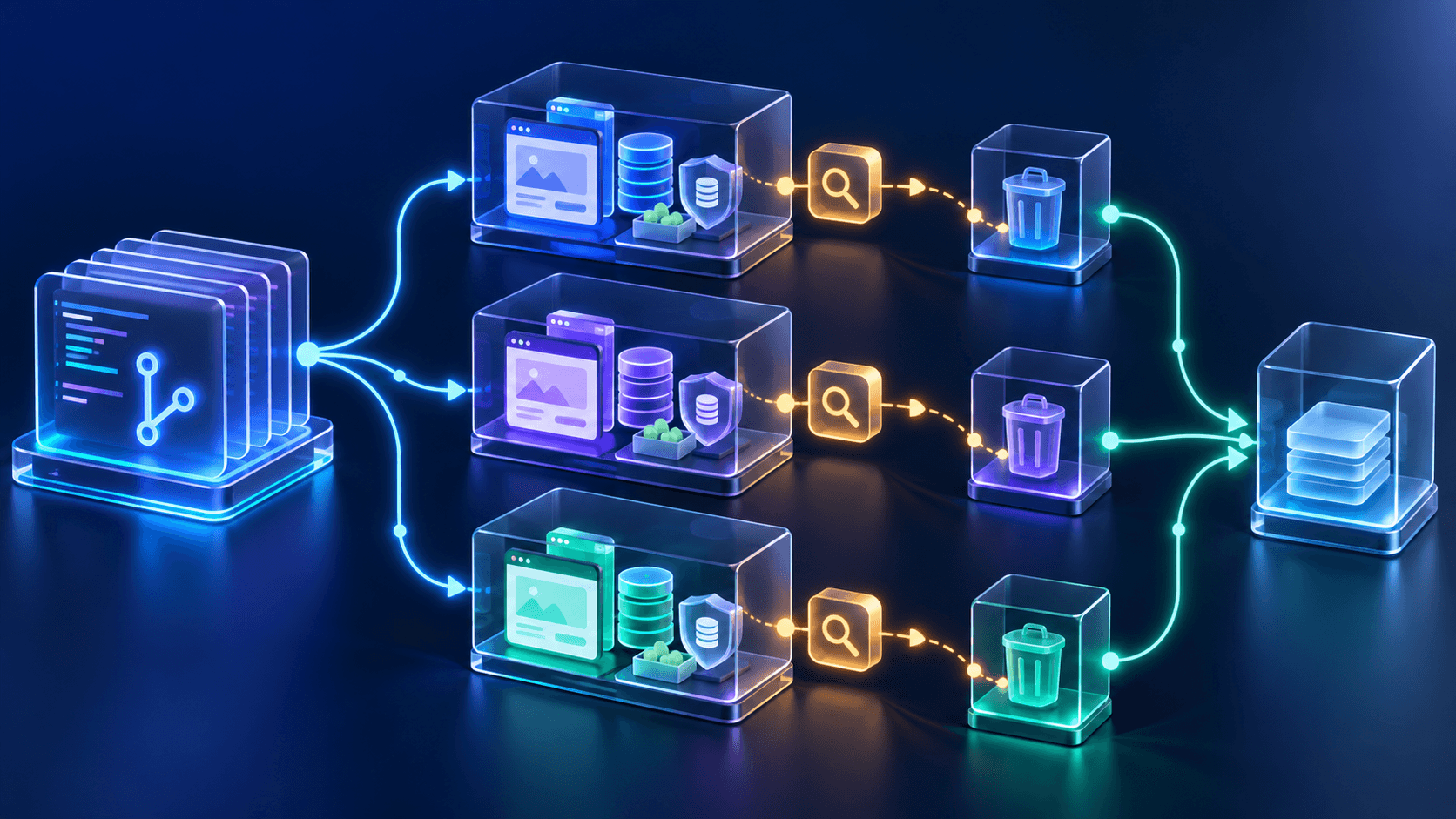
Define what a preview environment promises
A preview URL is useful only when reviewers know what it represents. Decide which pull requests receive an environment, which services are real or simulated, how authentication works, how long the environment lives, and which checks must pass before anyone treats it as reviewable.
Isolated
A branch cannot read, mutate, or exhaust another preview's application state.
Reproducible
The same commit, configuration class, migrations, and seed version explain what is running.
Disposable
Closing the pull request removes compute, data, credentials, DNS, and integrations predictably.
Display the commit SHA, build time, environment owner, data classification, and expiry in a small diagnostic page. A memorable URL is not sufficient deployment evidence.
Make creation an idempotent pull-request workflow
Generate a stable environment identifier from the repository and pull-request number rather than an arbitrary branch name. The pipeline should be safe to rerun after a partial failure: converge infrastructure, build an immutable artifact, apply compatible schema changes, seed approved data, deploy, run smoke tests, and finally publish the review URL.
pull request opened or updated
  → validate and test
  → build one immutable artifact
  → converge isolated dependencies
  → migrate and seed preview data
  → deploy the exact artifact
  → run smoke and accessibility checks
  → publish URL, commit, owner, and expiry
Do not mark the preview ready while migrations or seed work still runs. A failed update should keep the last known-good environment labeled with its older commit or remove it; silently serving stale code misleads reviewers.
Give previews their own identity and least-privilege configuration
Use an explicit preview environment class, not a production configuration with a different hostname. Scope credentials to the preview's storage prefix, database, queue namespace, callback URLs, and third-party sandbox account. Generate short-lived secrets through the deployment system and never expose server secrets through browser-readable variables or build logs.
- Allowlist the exact preview callback pattern for authentication providers.
- Set environment-specific cookie names and secure cookie attributes.
- Prefix object keys, queues, cache keys, and scheduled-job ownership.
- Disable outbound production integrations unless the test contract requires them.
Our Next.js environment-variable and secrets guide explains the client/server boundary behind these controls.
Use synthetic data by default and isolate every stateful dependency
The safest preview dataset is deterministic, synthetic, and small enough to rebuild. It should cover roles, empty states, long content, localization, failures, and realistic relationships without copying customer records. If production-derived data is unavoidable, establish an approved minimization and irreversible masking process before it enters a lower environment.
Choose per-preview databases for stronger boundaries or carefully managed schemas for lower cost. Whichever model you choose, test migrations against a fresh dataset and a dataset from the previous application version. Seed operations must be idempotent so retries do not create duplicate users, subscriptions, or fixtures.
Sandbox side effects before a reviewer clicks
Email, SMS, payments, analytics, search indexing, webhooks, and background jobs can cause real effects even when the Next.js deployment is temporary. Route them to vendor sandboxes, local capture services, or explicit no-send adapters. Make the active mode visible in the UI and logs.
- Reserve test recipient domains and block all other email or SMS destinations.
- Use provider test keys and preview-specific webhook signing secrets.
- Prevent preview pages and assets from entering production search indexes.
- Pause recurring jobs unless the review specifically needs them.
- Tag telemetry with environment ID, commit, and pull-request number.
When previews exercise asynchronous flows, retain the same durability principles described in our scheduled-jobs guide.
Treat every preview URL as an internet-facing application
An obscure hostname is not access control. Put previews behind identity-aware access, restrict them to authorized team members and invited reviewers, and preserve normal server-side authorization inside the application. Apply security headers, payload limits, dependency timeouts, and abuse controls just as you would for production.
Add noindex, nofollow, prevent previews from generating canonical URLs that compete with production, and ensure shared links do not reveal secrets in query strings. Keep pull requests from untrusted forks away from deployment credentials and protected networks; build them in a restricted path or require explicit approval.
Automate confidence before asking for human review
Run fast route smoke tests against the deployed URL, then check the changed user journey with representative roles and viewport sizes. Include accessibility checks, broken-link detection, console errors, failed network requests, and a basic performance budget. Human review should focus on behavior and product judgment, not discover that the environment never initialized.
Attach test results and the exact commit to the pull request. Use visual regression selectively for stable, important surfaces; approve intentional differences alongside the code so the baseline remains meaningful. For a broader testing structure, see our Next.js testing strategy.
Design deletion with the same care as creation
Pull-request closure should enqueue an idempotent teardown that removes application deployments, databases or schemas, object prefixes, caches, queues, DNS records, secrets, webhook endpoints, and observability resources. Deletion must tolerate missing components and resume after interruption.
Run a scheduled reconciler that compares live preview resources with open pull requests and expiry policy. Report orphaned resources, delete those past a safe grace period, and retain an audit record without retaining the customer-like test data itself. Budget by environment and set concurrency or time-to-live limits so a busy repository cannot create unbounded cost.
Next.js preview environment checklist
✓ Every preview identifies its commit, owner, and expiry
✓ Creation and teardown are idempotent and observable
✓ Credentials and stateful services are scoped per environment
✓ Seed data is synthetic, deterministic, and repeatable
✓ External side effects use sandboxes or capture adapters
✓ Authorized access and server-side authorization remain enforced
✓ Deployed smoke, accessibility, and journey checks run automatically
✓ A reconciler detects stale and orphaned resources
Build a more dependable Next.js application
Endurance Softwares helps teams design, build, test, and operate production-ready Next.js platforms.