


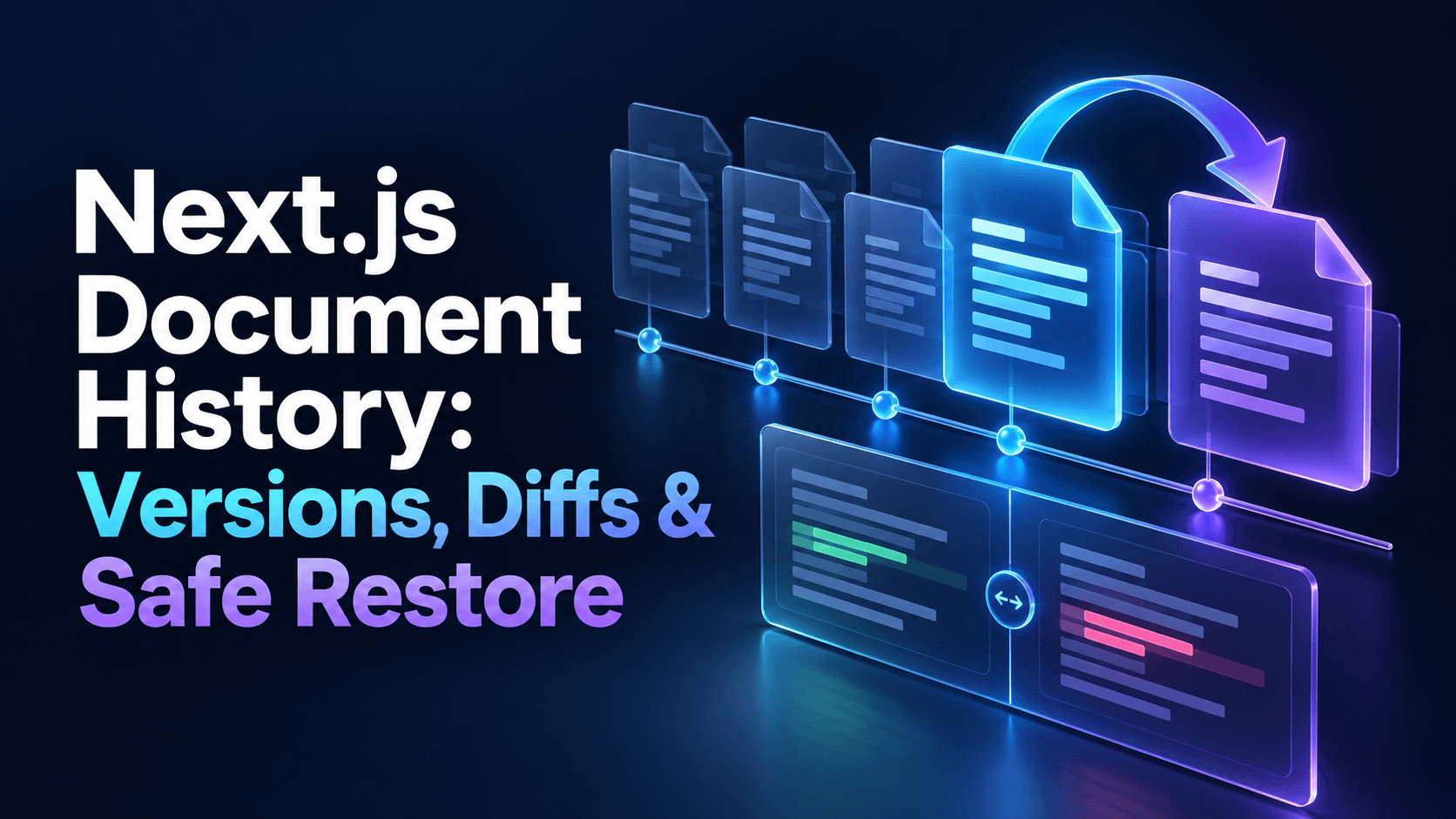
Separate the document from its revisions
Give the document a stable identity and each saved revision its own immutable identifier. The document points to its current revision; historical revisions capture content, content-schema version, actor, creation time, and the base revision used for the edit.
Define the save boundary. Every keystroke, autosave checkpoint, and intentionally published version need not become the same kind of historical item. Keep transient drafts separate from durable versions so a history panel communicates meaningful events rather than thousands of indistinguishable writes.
Commit content and the head pointer consistently
Authorize the edit against the document's current tenant and permissions, then compare the client's base revision to the current head. Persist the new revision and advance the head atomically. If another editor saved first, return a conflict with a recovery path instead of silently overwriting their work.
Use a request identity or equivalent uniqueness constraint to make repeated saves converge after a lost response. A browser should be able to learn that its save succeeded without creating a second identical revision. Audit metadata and any downstream indexing intent should agree with the committed content.
Make comparisons useful without exposing hidden data
Authorize access to both revisions before returning a comparison. A user allowed to see the current document is not automatically allowed to read a historical revision containing formerly restricted information. Define that policy explicitly for permission changes and redacted content.
Choose a diff appropriate to the content model. Structured fields, rich text blocks, and raw HTML require different presentation. Escape untrusted content and avoid executing historical markup. Show additions and removals using more than color, and offer readable labels for users navigating with assistive technology.
Restore by creating a new revision
When a user selects an older revision, show a preview and describe what will change. Recheck permissions and current head at confirmation. Create a new revision based on the selected historical content, with a restoration reference, rather than moving the pointer backward and erasing intervening history.
If the head changed after the preview, ask the user to review the new situation. Do not restore stale permissions, publication status, ownership, or deleted related records merely because their old values appeared in a document snapshot. Content restoration and operational side effects should have distinct rules.
Version attachments and derived output deliberately
Reference stable attachment identities or immutable object versions from each revision. If an attachment URL always points at the latest uploaded bytes, an old revision may display new content and cease to be trustworthy history.
Define what happens when attachments are quarantined, removed, or purged. Historical access must still enforce current security restrictions. Generated PDFs, search entries, and previews should identify their source revision so the user can distinguish a restored document from an obsolete derived artifact.
Explain what history does not preserve forever
Set a retention policy for revisions, drafts, attachments, and audit records. A soft-deleted document, an expired revision, and an irreversibly purged object are different states. Keep the interface honest about which versions remain restorable.
Store enough safe metadata to explain a missing revision without retaining the sensitive content indefinitely. If deletion obligations or internal policy require historical redaction, apply a controlled redaction workflow rather than assuming immutable history overrides every other requirement. Obtain appropriate policy advice for the actual business context.
Test recovery with races and missing dependencies
Test duplicate save delivery, concurrent edits, a restore preview followed by another user's save, historical content with unsafe markup, removed attachments, downgraded permissions, and a revision that has passed its retention deadline.
Give the history screen clear version labels, author attribution, timestamps with explicit context, and an accessible comparison mode. Record restoration outcomes and provide a direct link to the new current revision. Users should be able to explain what was restored, who authorized it, and why later edits were preserved.
Build a more dependable Next.js application
Endurance Softwares helps teams design, build, test, and operate production-ready Next.js platforms.