


Monolithic vs Microservices vs Serverless: Complete…
Every SaaS product starts with one critical decision: how should we architect the backend?
Most teams jump into tools first. But the real decision is architectural: Monolith, Microservices, or Serverless.
At Endurance Softwares, we have built everything from MVPs to enterprise platforms, and one thing is clear: there is no single best architecture. There is only the right architecture for your current stage.

Introduction
Should you build a Monolith, split into Microservices, or go fully Serverless? This guide breaks down each model practically, with real SaaS scenarios.
What is Monolithic Architecture?
Definition
A monolithic architecture is a single unified application where API, business logic, database access, authentication, and often UI are tightly coupled and deployed as one service.
Example (Real SaaS MVP)
For a product like TrackLabs, a monolith may look like:
/app
  /auth
  /users
  /tasks
  /analytics
  server.js
- One Node.js server
- One PostgreSQL database
- One deployment (for example Render or Vercel)
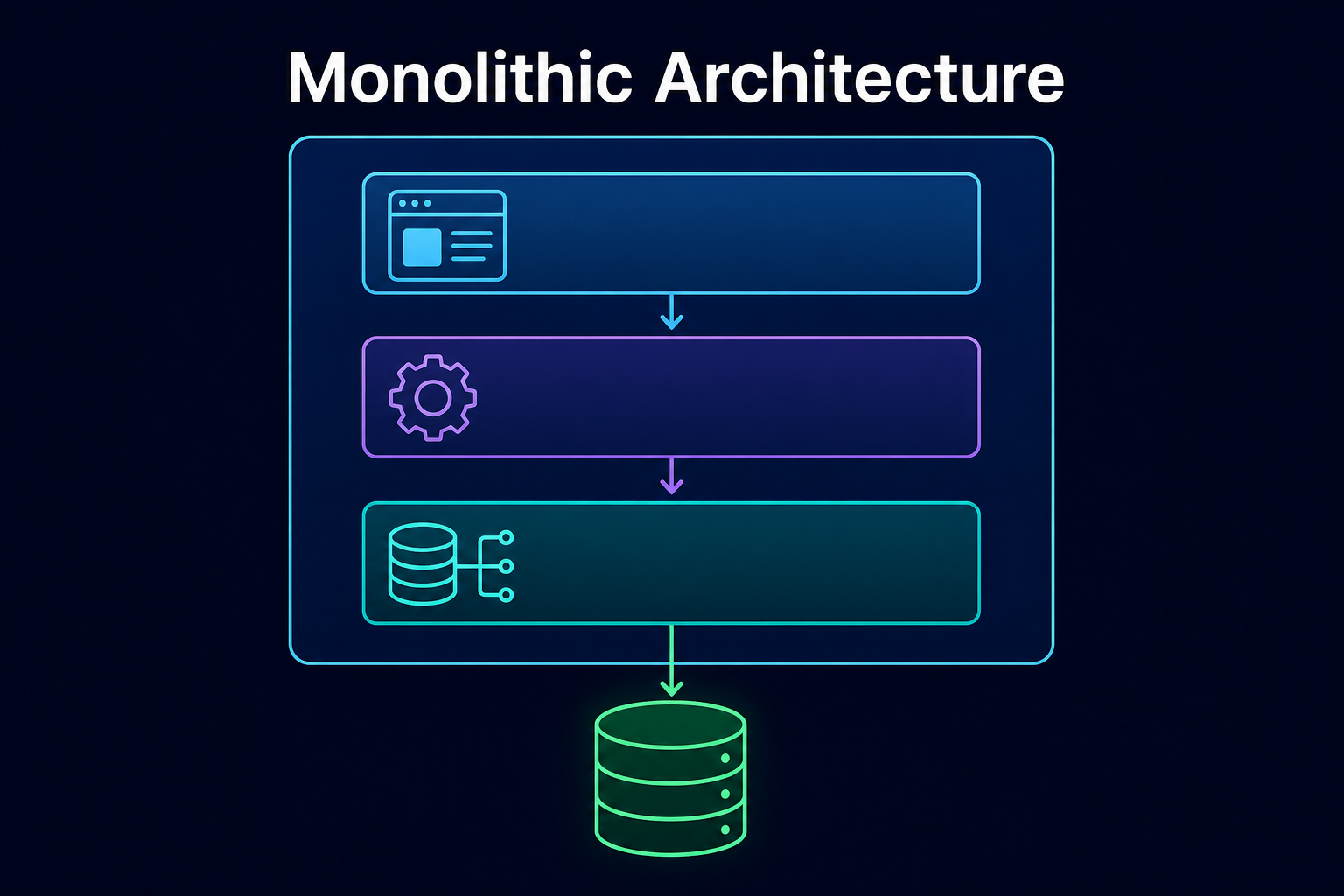
Structure
[ Client (Web / Mobile) ]
            ↓
     [ Monolithic App ]
   (API + Logic + Auth)
            ↓
        [ Database ]
Example Stack
- Frontend: Next.js
- Backend: Node.js (Express)
- DB: PostgreSQL or Supabase
- Hosting: Vercel or Render
Real Example (TrackLabs MVP)
- `/api/auth`
- `/api/tasks`
- `/api/users`
- `/api/analytics`
All inside one codebase.
Key Insight: Fastest way to launch, best for 0 to 10K users.
Advantages
- Simple to build
- Faster MVP development
- Easy debugging
- Lower infrastructure complexity
Limitations
- Hard to scale independently
- Codebase becomes messy over time
- Slower deployments as the app grows
- Single point of failure
When to Use
- MVP stage
- Small team (1-5 developers)
- Early-stage SaaS
What is Microservices Architecture?
Definition
Microservices architecture breaks the application into independent services, each responsible for a specific domain, with separate deployment and ownership boundaries.
Example (Scaling SaaS Platform)
Auth Service         -> /auth-service
User Service         -> /user-service
Task Service         -> /task-service
Analytics Service    -> /analytics-service
Notification Service -> /notification-service
Each service runs independently and communicates via APIs or queues.
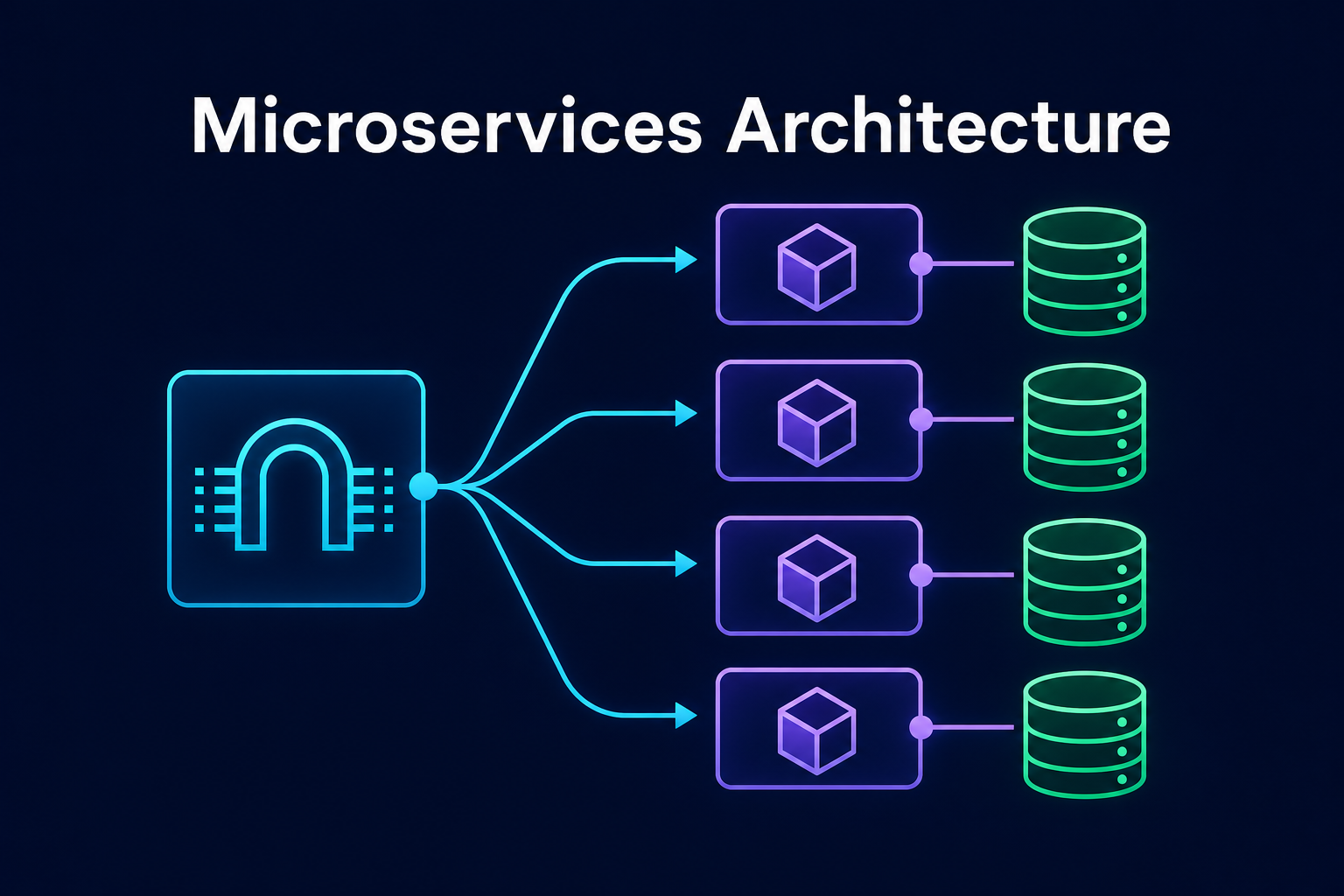
Structure
          [ Client ]
              ↓
        [ API Gateway ]
   ┌─────────┼─────────┐
   ↓         ↓         ↓
[Auth]   [Users]   [Tasks]
   ↓         ↓         ↓
 DB1       DB2       DB3
Optional queue layer: Kafka or SQS.
Example Stack
- API Gateway: Nginx or Kong
- Services: Node.js, NestJS, or Python
- Databases: separate DB per service
- Communication: REST, gRPC, or Kafka
Real Example (Scaling SaaS)
- Auth Service: login and JWT
- User Service: profiles
- Task Service: core logic
- Analytics Service: reports
- Notification Service: emails
Key Insight: Scale teams, not just systems.
Advantages
- Independent scaling
- Faster team collaboration
- Fault isolation
- Technology flexibility
Limitations
- Complex to manage
- Requires DevOps maturity
- Network latency and orchestration overhead
- Harder debugging in distributed systems
When to Use
- Product-market fit achieved
- Multiple teams working in parallel
- High scalability requirements
What is Serverless Architecture?
Definition
Serverless architecture removes direct server management. You write functions and cloud infrastructure executes them on demand.
Example (Modern SaaS Backend)
- API routes: AWS Lambda or Vercel Functions
- Database: Supabase or DynamoDB
- Auth: Firebase or Clerk
User Request -> API Gateway -> Lambda Function -> Database
Structure
[ Client ]
    ↓
[ API Gateway ]
    ↓
[ Lambda Functions ]
    ↓
[ DB / Storage / External APIs ]
Real Example
- /api/create-user to Lambda
- /api/payment-webhook to Lambda
- /api/send-email to Lambda
Key Insight: Zero infrastructure management with auto scaling.
Advantages
- No server management
- Auto-scaling
- Pay-per-use can be cost efficient early
- Fast deployment cycles
Limitations
- Cold starts
- Vendor lock-in risk
- Limited execution time
- Challenging for complex workflows
When to Use
- Event-driven applications
- Low to medium traffic SaaS
- Rapid development environments
Monolithic vs Microservices vs Serverless (Comparison)
- Complexity: Monolithic (low), Microservices (high), Serverless (medium)
- Scalability: Monolithic (limited), Microservices (high), Serverless (auto-scale)
- Deployment: Monolithic (single), Microservices (multiple), Serverless (functions)
- Cost: Monolithic (low initially), Microservices (higher infra), Serverless (pay-per-use)
- MVP speed: Monolithic (fastest), Microservices (slower), Serverless (fast)
- Maintenance: Monolithic (hard later), Microservices (easier modular), Serverless (depends)
Real-World Architecture Evolution
Stage 1: Monolith (0 to 10K users)
- Next.js + Node.js backend
- Single DB (PostgreSQL or Supabase)
- Fast iteration loop
Goal: validate idea quickly.
Stage 2: Hybrid (10K to 100K users)
Extract critical services such as Auth, Payments, and Notifications.
Goal: partial microservices where bottlenecks appear.
Stage 3: Microservices + Serverless (100K+ users)
Use microservices for core domains and serverless for jobs, webhooks, and events.
Goal: scale while optimizing cost and operational flexibility.
Real-World Hybrid Architecture (Production SaaS)
This is what usually wins in 2026: a practical hybrid of monolith, microservices, and serverless.
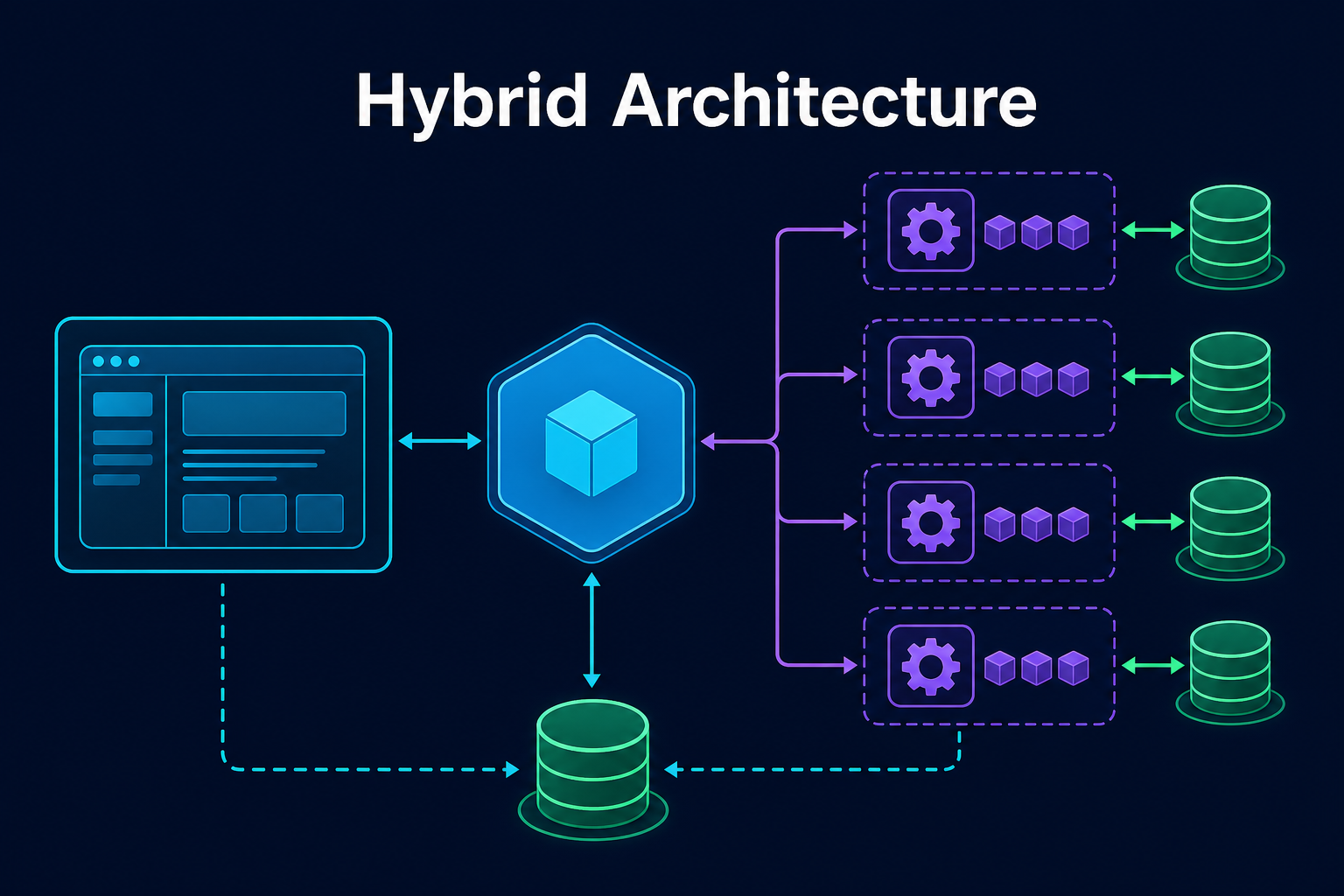
Structure
                [ Client (Web/App) ]
                        ↓
                 [ Next.js Frontend ]
                        ↓
                  [ API Layer ]
                        ↓
        ┌───────────────┼───────────────┐
        ↓               ↓               ↓
 [ Core Monolith ] [ Microservices ] [ Serverless ]
        ↓               ↓               ↓
     [ Main DB ]     [ Service DBs ]  [ Event Tasks ]

              + Message Queue (Kafka / SQS)
              + Storage (S3)
              + Analytics Layer
Example Stack
- Frontend: Next.js (App Router)
- Backend: Node.js + NestJS
- Database: PostgreSQL (Supabase)
- Serverless: Vercel Functions or AWS Lambda
- Queue: Kafka or SQS
- Auth: Clerk or Supabase Auth
Real Example (Production SaaS)
Core Monolith: user dashboard, core API, auth.
Microservices: payments, analytics engine, notifications.
Serverless: webhooks, cron jobs, email triggers.
Why this works: Monolith for speed, Microservices for scale, Serverless for efficiency.
Real Example (Production Scenario)
SaaS: Subscription Platform
Monolith version: `/api/users`, `/api/payments`, `/api/analytics` in one service.
Microservices version: User Service (Node.js), Payment Service (Stripe), Analytics Service (Python).
Serverless add-on: Stripe webhooks, email notifications, scheduled jobs.
Common Mistakes
Starting with Microservices too early
This often slows product development before product-market fit.
Going fully Serverless without understanding limits
Can create debugging and observability pain points.
Keeping monolith too long
May create scaling, reliability, and release bottlenecks.
Final Recommendation
If you are a startup: start with Monolith (Next.js + Node + DB).
If you are scaling: move to Hybrid Microservices.
If you are optimizing cost and performance: add Serverless components.
Final Architecture Rule
Do not start distributed. Do not over-engineer.
Start simple. Extract intelligently. Scale when the system proves the need.
Final Thoughts
Architecture should evolve with your product, not your ego. The best systems are simple at the start, modular over time, and scalable when needed.