


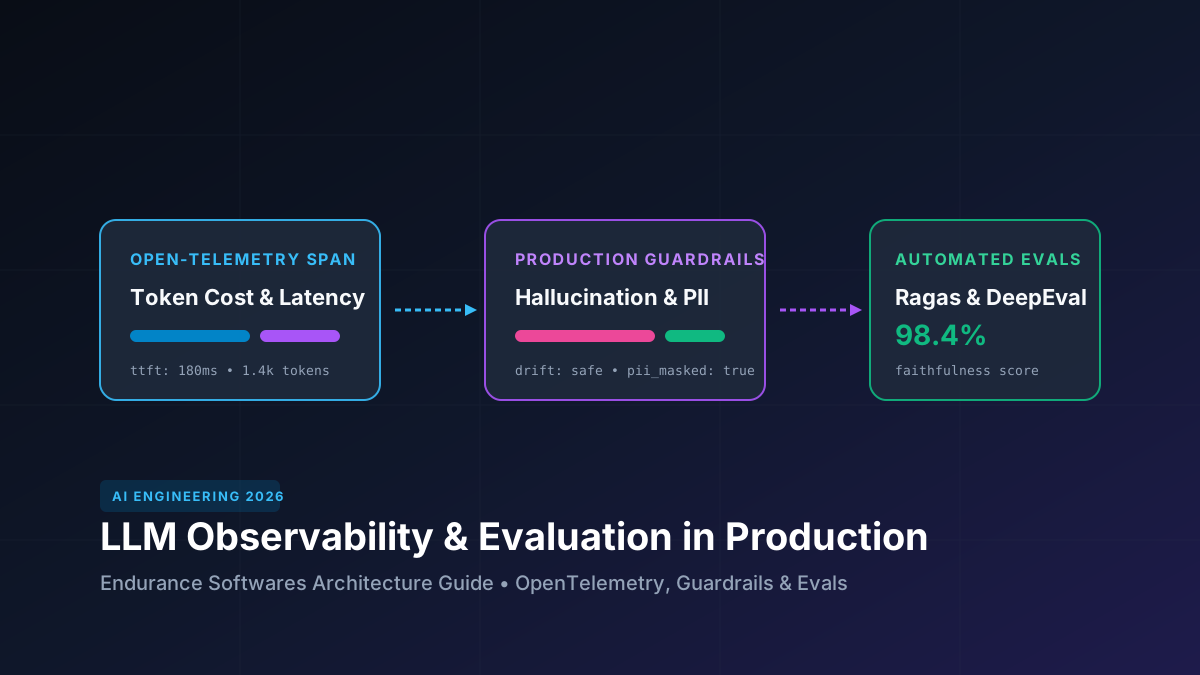
Standard software application performance monitoring (APM) tools measure CPU, memory, and HTTP status codes, but they are blind to LLM failure modes like hallucination, prompt injection, context truncation, and semantic drift. A production-ready AI observability platform must combine OpenTelemetry semantic conventions for GenAI, sub-cent multi-tenant cost tracking, inline safety guardrails (PII/toxicity), and offline asynchronous evaluation pipelines.
The 4 Pillars of LLM Telemetry in Production
Traditional APM answers "Did the server return 200 OK?". LLM observability answers"Did the model provide a factual, compliant, cost-effective answer that actually helped the user?"
| Pillar | Traditional Web APM | LLM Production Observability |
|---|---|---|
| Tracing | HTTP request/response spans | Nested spans: Prompt templates, Vector DB retrieval, Rerankers, Tool calls, LLM generation |
| Performance | Server latency (p95 / p99 ms) | Time to First Token (TTFT), Inter-token latency, Token generation velocity (tokens/sec) |
| Cost & Quotas | Server instance hours ($/mo) | Exact per-tenant input/output token metering, caching hit-rates, and model routing efficiency |
| Quality Gates | Unit test assertions (exact match) | Faithfulness, Answer Relevance, Semantic Cosine Similarity, Hallucination score (0.0 to 1.0) |
Instrumenting Distributed LLM Tracing with OpenTelemetry
The OpenTelemetry GenAI Semantic Conventions standardize how prompt tokens, model parameters, and system outputs are captured across microservices. Below is an enterprise-grade TypeScript wrapper for invoking foundational models with native tracing, tenant scoping, and cost attribution:
import { trace, context, SpanStatusCode } from "@opentelemetry/api";
import { countTokens } from "@anthropic-ai/tokenizer";

const tracer = trace.getTracer("ai-agent-service", "2026.1.0");

export async function runTrackedLlmCall({
  userId,
  tenantId,
  prompt,
  systemPrompt,
  model = "claude-3-5-sonnet",
  maxTokens = 2048,
}) {
  return tracer.startActiveSpan("llm.generation", async (span) => {
    const startTime = performance.now();
    const promptTokens = countTokens(systemPrompt + "\n" + prompt);

    span.setAttributes({
      "gen_ai.system": "anthropic",
      "gen_ai.request.model": model,
      "gen_ai.request.max_tokens": maxTokens,
      "gen_ai.usage.prompt_tokens": promptTokens,
      "app.tenant_id": tenantId,
      "app.user_id": userId,
    });

    try {
      const response = await fetch("https://api.anthropic.com/v1/messages", {
        method: "POST",
        headers: {
          "x-api-key": process.env.ANTHROPIC_API_KEY,
          "anthropic-version": "2023-06-01",
          "content-type": "application/json",
        },
        body: JSON.stringify({
          model,
          max_tokens: maxTokens,
          system: systemPrompt,
          messages: [{ role: "user", content: prompt }],
        }),
      });

      if (!response.ok) {
        throw new Error(`LLM provider returned status ${response.status}`);
      }

      const data = await response.json();
      const outputText = data.content?.[0]?.text ?? "";
      const completionTokens = data.usage?.output_tokens ?? countTokens(outputText);
      const totalTokens = promptTokens + completionTokens;
      const durationMs = performance.now() - startTime;

      // Estimate Cost in micro-cents
      const costMicroCents = calculateCost(model, promptTokens, completionTokens);

      span.setAttributes({
        "gen_ai.usage.completion_tokens": completionTokens,
        "gen_ai.usage.total_tokens": totalTokens,
        "gen_ai.response.model": data.model,
        "gen_ai.response.finish_reasons": [data.stop_reason],
        "app.cost_microcents": costMicroCents,
        "app.duration_ms": durationMs,
      });

      span.setStatus({ code: SpanStatusCode.OK });
      return { outputText, promptTokens, completionTokens, costMicroCents, durationMs };
    } catch (error) {
      span.recordException(error);
      span.setStatus({
        code: SpanStatusCode.ERROR,
        message: error instanceof Error ? error.message : "Unknown LLM error",
      });
      throw error;
    } finally {
      span.end();
    }
  });
}
By tagging spans with app.tenant_id and gen_ai.usage.total_tokens, engineering teams can immediately build Grafana dashboards or pipe telemetry directly into specialized LLM backends like Langfuse, Arize Phoenix, or Datadog LLM Observability.
Granular Multi-Tenant Cost Attribution
Without strict token budgets, a few rogue enterprise customers or infinite agentic loops can bankrupt an AI SaaS startup in hours. Implement rate-limiting at both the request rate and token budget levels:
- Token Bucket per Tenant: Enforce daily and monthly soft/hard token ceilings in Redis.
- Prompt Compression: Strip redundant whitespace, markdown noise, and repetitive conversation histories before calling LLM APIs.
- Semantic Caching: Cache high-frequency embedding queries in Redis to bypass LLM inference entirely for repeated questions (up to 40% cost reduction).
- Model Cascading: Route easy queries to fast/cheap models (Claude 3.5 Haiku or GPT-4o Mini) and escalate complex queries to frontier reasoning models.
Real-Time Safety Guardrails: Pre-Inference & Post-Inference
Guardrails must run as low-latency checkpoints around the model invocation:
Never allow raw LLM output into user-facing webhooks or database writes without validating structural conformity (e.g., via Zod schemas) and redacting personally identifiable information (credit cards, emails, phone numbers).
Automated Evaluation: Continuous Testing with Ragas & DeepEval
Continuous evaluation compares your AI agent's generated responses against ground truth benchmarks and retrieved contexts. Here is an implementation of an automated asynchronous evaluation step:
import { evaluate } from "ragas-client";
import { detectPII, checkToxicity } from "@guardrails/safety";

export async function runProductionEvaluation({
  question,
  retrievedContexts,
  generatedAnswer,
  groundTruth = null,
}) {
  // 1. Guardrails Layer (Low Latency Pre/Post checks)
  const piiCheck = detectPII(generatedAnswer);
  if (piiCheck.hasSensitiveData) {
    return {
      passed: false,
      reason: "PII_LEAK_DETECTED",
      sanitizedAnswer: piiCheck.redactedText,
    };
  }

  // 2. Automated RAG Evals Layer (Async telemetry pipeline)
  const evalResults = await evaluate({
    metrics: ["faithfulness", "answer_relevance", "context_precision"],
    data: {
      question,
      contexts: retrievedContexts,
      answer: generatedAnswer,
      ground_truth: groundTruth,
    },
  });

  const { faithfulness, answer_relevance, context_precision } = evalResults;

  // Threshold compliance check
  const isHealthy =
    faithfulness >= 0.85 &&
    answer_relevance >= 0.80 &&
    context_precision >= 0.75;

  return {
    passed: isHealthy,
    scores: {
      faithfulness,
      answerRelevance: answer_relevance,
      contextPrecision: context_precision,
    },
  };
}Detecting Prompt & Model Drift
Foundation model providers regularly push silent updates that change instruction following behaviors, response formats, and safety boundaries. To catch regressions before your customers do:
- Golden Benchmark Dataset: Maintain a curated dataset of 200–500 realistic prompts covering edge cases.
- CI/CD Eval Action: Trigger automated evaluation runs on every pull request that touches system prompts, vector chunking, or model configurations.
- Production Shadowing: Route 5% of production traffic to newly proposed prompts or model versions in shadow mode to compare output quality in real time.
Production Readiness Checklist
✓ OpenTelemetry spans wrap all LLM, RAG retrieval, and tool execution steps
✓ Prompt and completion token counts attributed to tenant ID
✓ Hard token quotas and rate limits enforced in Redis
✓ Automated PII detection and masking active in post-processing
✓ Asynchronous Ragas evaluation pipeline monitors faithfulness
✓ Golden benchmark suite integrated into CI/CD build pipeline
✓ Structured output validated with Zod/JSON Schema before execution
✓ Fallback providers configured for 99.99% uptime during API outages
Build Production-Grade AI Systems with Endurance Softwares
Our engineering team designs scalable AI architectures, RAG systems, and enterprise LLM pipelines with bulletproof observability and safety guardrails.
Consult With Our AI ArchitectsFrequently Asked Questions
What is the difference between LLM observability and traditional APM?
Traditional APM tracks server health, latency, and error codes. LLM observability tracks the quality, correctness, token economics, and safety of generative outputs (hallucinations, prompt injections, context relevance).
How can I reduce LLM observability latency overhead?
Use non-blocking asynchronous OpenTelemetry batch exporters (such as OTLP over gRPC) and perform heavy LLM-as-a-judge quality assessments out-of-band using background job workers (e.g., BullMQ or Temporal).
Which metrics are most critical for RAG applications?
The RAG triad: Context Relevance (did the retriever find the right information?),Faithfulness (is the answer grounded strictly in the context?), andAnswer Relevance (did the response directly solve the user query?).