


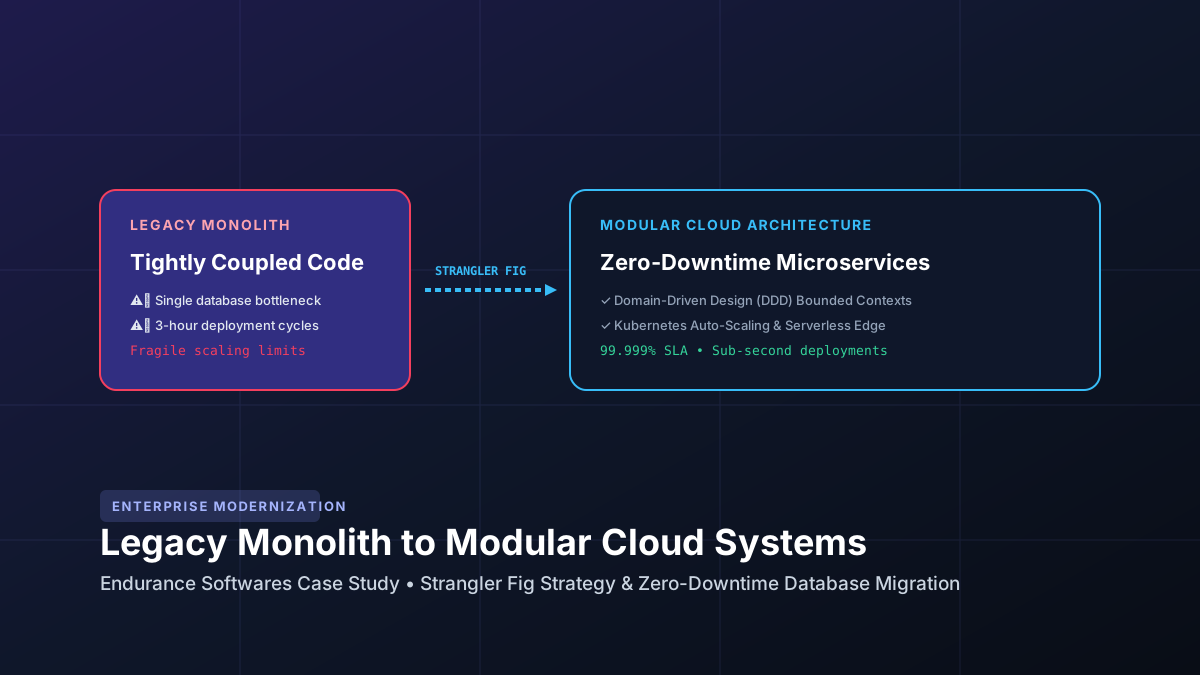
Legacy monoliths accumulate years of valuable business logic alongside crippling technical debt. A disciplined modernization strategy carves out high-value domains into independent, cloud-native microservices while keeping the legacy core fully operational throughout the transition.
The "Big Bang Rewrite" Trap
Industry studies demonstrate that over 65% of complete software rewrites exceed budget, fall years behind schedule, or get canceled entirely. Why? Because the legacy monolith is a moving target: while the new system is being built, business requirements evolve, bugs are fixed in the old codebase, and feature parity remains unreachable.
| Strategy Dimension | Big Bang Rewrite (High Risk) | Endurance Strangler Fig Modernization |
|---|---|---|
| Time to First Value | 18 to 36 months of zero business ROI | 4 to 8 weeks (first service live) |
| Deployment Risk | Catastrophic cutover weekend failure risk | Canary traffic routing (1% → 10% → 100%) |
| Team Burnout | Extreme (Maintaining legacy + building new) | Controlled, steady domain ownership handoffs |
| Business Continuity | Feature freeze for months | Continuous feature releases during migration |
The Strangler Fig Architecture & Edge Interception
Named after Australian strangler figs that gradually envelop host trees, this pattern places an intelligent routing proxy at the perimeter. Incoming requests are inspected, and migrated endpoints are seamlessly redirected to modern cloud services while legacy routes remain untouched:
// strangler-proxy.ts - Dynamic Traffic Interceptor for Zero-Downtime Cutover
import { NextRequest, NextResponse } from "next/server";

// Feature flag cutover percentage per tenant
const CUTOVER_REGISTRY = new Map<string, number>([
  ["tenant_billing_v2", 100], // 100% routed to new Cloud Microservice
  ["tenant_inventory_v2", 45], // 45% Canary rollout
]);

export function middleware(req: NextRequest) {
  const path = req.nextUrl.pathname;
  const tenantId = req.headers.get("x-tenant-id") || "anonymous";

  // Check if route is being strangled from legacy monolith
  if (path.startsWith("/api/v1/billing")) {
    const rolloutPercent = CUTOVER_REGISTRY.get("tenant_billing_v2") ?? 0;
    const shouldRouteToModernMicroservice = hashTenantRollout(tenantId) < rolloutPercent;

    if (shouldRouteToModernMicroservice) {
      // Forward request to new Kubernetes Node.js microservice
      const newServiceUrl = new URL(path.replace("/api/v1", "/api/v2"), process.env.MODERN_MICROSERVICE_URL);
      return NextResponse.rewrite(newServiceUrl, {
        headers: { "x-routed-by": "strangler-fig-v2" },
      });
    }
  }

  // Fallback to legacy Monolith
  return NextResponse.next();
}

function hashTenantRollout(id: string): number {
  let hash = 0;
  for (let i = 0; i < id.length; i++) hash = (hash << 5) - hash + id.charCodeAt(i);
  return Math.abs(hash % 100);
}
Domain-Driven Decomposition: Identifying Bounded Contexts
Never slice microservices along arbitrary technical layers (e.g. "the database layer" or "the auth layer"). Instead, apply Domain-Driven Design (DDD) to isolate distinct business aggregates:
Zero-Downtime Database Splitting & Dual-Writing
Splitting a shared 2-terabyte relational monolith database is the most critical phase:
- Phase 1 (Dual Writing): The modern microservice writes to both the new isolated PostgreSQL instance and the legacy database via an asynchronous outbox queue.
- Phase 2 (Shadow Verification): Background reconciliation scripts compare row parity and data integrity across both databases in real time.
- Phase 3 (Cutover): The modern database becomes the authoritative master, and the legacy database write path is permanently deprecated.
Enterprise Case Study: Logistics & Supply Chain Modernization
Endurance Softwares recently modernized a 10-year-old enterprise logistics platform processing $250M in annual freight volume:
- Deployment Frequency: Increased from once every 3 weeks to 14 automated production deployments per day.
- P99 API Latency: Dropped from 2,800ms down to 120ms.
- Infrastructure Costs: Reduced monthly cloud spend by 48% through auto-scaling Kubernetes containers.
- Zero Downtime: 100% continuous customer uptime maintained across all 8 migration phases.
Modernization Readiness Checklist
✓ Strangler proxy deployed at edge to control traffic routing
✓ Bounded contexts mapped with clear domain ownership
✓ Anti-Corruption Layer (ACL) insulates modern microservices
✓ Dual-write synchronization validates data integrity
✓ Automated rollback mechanisms configured for every canary release
✓ Distributed tracing links legacy and modern service spans
✓ Contract testing (Pact) ensures backward compatibility
✓ Comprehensive business metric dashboards monitor SLA health
Modernize Your Legacy Architecture with Endurance Softwares
Our senior enterprise architects deconstruct legacy debt and build high-performance, cloud-native systems tailored to your business needs.
Book a Legacy Modernization AssessmentFrequently Asked Questions
How do you handle shared database foreign keys across microservices?
We replace direct SQL database joins with event-driven data replication (using Kafka or PostgreSQL CDC) and resolve cross-domain entity IDs via GraphQL Federation or REST API gateways.
What is an Anti-Corruption Layer (ACL)?
An ACL is an adapter translation layer that translates legacy data schemas and outdated domain concepts into clean, modern domain models, protecting your new microservice from legacy design flaws.
Can our in-house team continue building features during the migration?
Yes! That is the core superpower of the Strangler Fig pattern. Your team continues releasing business features while Endurance Softwares incrementally modernizes underlying backend subsystems.