


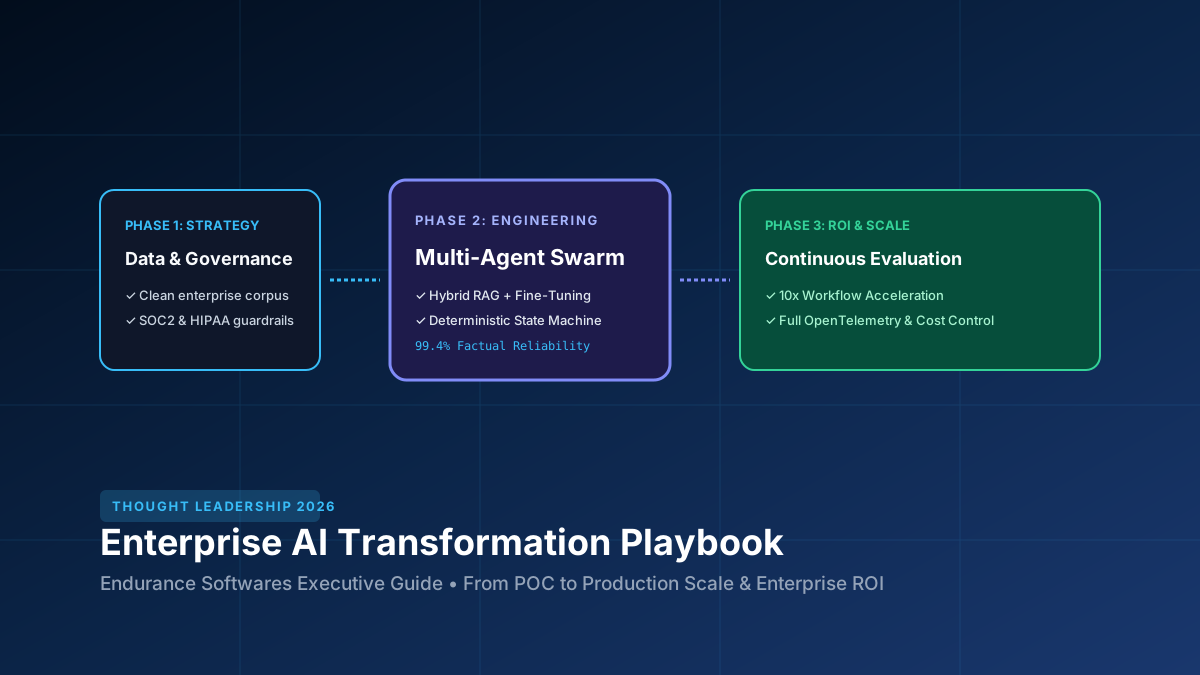
Enterprise AI success is an engineering discipline, not a prompt engineering trick. Organizations that win in 2026 focus on clean data pipelines, hybrid dense/sparse retrieval augmented generation (RAG), deterministic state graphs with human-in-the-loop validation, and continuous automated quality evals. Endurance Softwares empowers forward-thinking CIOs and CTOs to scale robust AI systems with measurable business outcomes.
Why 78% of Enterprise AI Pilots Fail in Production
Building a flashy ChatGPT wrapper or standalone chatbot demo is easy. Deploying an AI agent that touches confidential enterprise databases, complies with HIPAA/SOC2 requirements, and executes complex multi-step business transactions without hallucinating requires deep systems engineering.
| Failure Mode | Root Cause in Fragile POCs | Endurance Softwares Production Solution |
|---|---|---|
| Hallucinations & Drift | Unstructured naive vector search & uncalibrated prompts | Hybrid Dense/Sparse RAG + Cross-Encoder Re-ranker + Ragas evals |
| Data Security Breaches | Sending raw PII/PHI to public LLM endpoints | Client-side PII tokenization, VPC private endpoints, on-prem models |
| Infinite Agent Loops | Unbounded autonomous LLM recursion | Deterministic LangGraph state graphs with strict execution budgets |
| Unclear Business ROI | Technology-first vanity experiments | KPI-driven workflow automation with measured hours saved per FTE |
The 4-Stage Enterprise AI Scaling Playbook
- Phase 1: Enterprise Data Foundation: Ingest, deduplicate, tokenize, and chunk internal knowledge bases, ERP tables, and documentation. Establish strict Row-Level Security (RLS) so agents never leak cross-department data.
- Phase 2: Architecture & Guardrails: Design stateful multi-agent systems with explicit supervisor routers, fallback providers, and semantic caching layers.
- Phase 3: Controlled Shadow Deployment: Run AI agents in shadow mode against live production traffic, evaluating accuracy against human expert golden benchmarks.
- Phase 4: Full Production Rollout: Enable automated tool execution with human-in-the-loop approval thresholds and real-time OpenTelemetry tracking.
The Strategic Decision: Advanced RAG vs Fine-Tuning
A common misconception is that enterprise AI requires fine-tuning foundation models from scratch. In 90% of business applications, an Advanced Hybrid RAG architecture is superior because knowledge updates dynamically in milliseconds without million-dollar retraining cycles:
- Use Hybrid RAG: For real-time data, changing product catalogs, policy documents, and customer records.
- Use Fine-Tuning (LoRA/QLoRA): To teach models proprietary formatting styles, domain-specific nomenclature (e.g., specialized medical or legal syntaxes), or cost-effective task distillation into 8B parameter models.
Production Multi-Agent State Machine Architecture
Below is a production-grade multi-agent architecture implemented by Endurance Softwares using LangGraph, incorporating sandboxed data execution and security gatekeeping:
// enterprise-ai-pipeline.ts - Production Multi-Agent Execution Pipeline
import { StateGraph, END } from "@langchain/langgraph";
import { runSecurityGuardrail } from "./guardrails";
import { executeSandboxedSql } from "./tools/sql";
import { queryKnowledgeBase } from "./tools/rag";

interface AgentWorkflowState {
  userQuery: string;
  tenantId: string;
  retrievedContext: string[];
  sqlResults?: any[];
  agentPlan: string[];
  draftResponse: string;
  securityVerdict: "APPROVED" | "REJECTED";
}

// 1. Supervisor Agent decomposes user intent
async function supervisorNode(state: AgentWorkflowState) {
  const plan = await generateDecompositionPlan(state.userQuery);
  return { agentPlan: plan };
}

// 2. Data Extraction Agent (Sandboxed Read-Only)
async function dataExtractionNode(state: AgentWorkflowState) {
  const context = await queryKnowledgeBase(state.tenantId, state.userQuery);
  const sql = await executeSandboxedSql(state.tenantId, state.userQuery);
  return { retrievedContext: context, sqlResults: sql };
}

// 3. Synthesis & Evaluation Node
async function synthesisNode(state: AgentWorkflowState) {
  const answer = await generateGroundedAnswer(state);
  const verdict = await runSecurityGuardrail(answer);
  return { draftResponse: answer, securityVerdict: verdict };
}

// State Graph Assembly with Deterministic Transition Routing
const workflow = new StateGraph<AgentWorkflowState>({
  channels: {
    userQuery: { value: (x, y) => y ?? x, default: () => "" },
    tenantId: { value: (x, y) => y ?? x, default: () => "" },
    retrievedContext: { value: (x, y) => y ?? x, default: () => [] },
    sqlResults: { value: (x, y) => y ?? x },
    agentPlan: { value: (x, y) => y ?? x, default: () => [] },
    draftResponse: { value: (x, y) => y ?? x, default: () => "" },
    securityVerdict: { value: (x, y) => y ?? x, default: () => "APPROVED" },
  },
});

workflow.addNode("supervisor", supervisorNode);
workflow.addNode("data_extractor", dataExtractionNode);
workflow.addNode("synthesizer", synthesisNode);

workflow.addEdge("supervisor", "data_extractor");
workflow.addEdge("data_extractor", "synthesizer");
workflow.addConditionalEdges("synthesizer", (state) =>
  state.securityVerdict === "APPROVED" ? END : "supervisor"
);

export const enterpriseAiApp = workflow.compile();
Enterprise Data Governance, Sovereignty & Security
Enterprise AI transformation requires zero-trust security. Key technical guardrails include:
- Zero Data Retention (ZDR): Enforce enterprise API agreements guaranteeing customer data is never used to train foundation models.
- Local / Dedicated VPC Hosting: Deploy open-weights models (such as Llama-3 or Mistral Large) inside client AWS/Azure private clusters for classified data.
- Field-Level Cryptographic Masking: Redact SSNs, credit cards, and patient identifiers before prompt embedding creation.
Measuring Hard ROI: From Experiments to Bottom-Line Profit
We partner with C-suite stakeholders to establish quantifiable metrics:
- Resolution Velocity: Slashing tier-1 customer support handling times from 18 minutes down to 45 seconds.
- Document Ingestion: Automating 5,000-page vendor invoice reconciliations with 99.8% precision.
- Engineering Velocity: Boosting developer sprint throughput by 35% through custom internal codebase copilots.
Enterprise AI Transformation Checklist
✓ Strategic business use cases mapped with measurable ROI targets
✓ Clean data ingestion pipeline with automated chunking and RLS
✓ Multi-agent supervisor pattern enforces deterministic state flow
✓ Automated PII redaction and prompt injection filters active
✓ Continuous evaluation framework monitors faithfulness & drift
✓ Zero Data Retention (ZDR) enterprise agreements confirmed
✓ Human-in-the-loop approval gates high-stakes financial operations
✓ OpenTelemetry distributed tracing captures all token costs
Accelerate Your AI Roadmap with Endurance Softwares
We architect, build, and deploy production-grade enterprise AI systems that drive real business growth. Speak with our Chief AI Architect today.
Schedule an Enterprise AI Strategy SessionFrequently Asked Questions
How long does an enterprise AI transformation project typically take?
With Endurance Softwares' agile pod model, our teams deliver an MVP production pipeline within 4 to 6 weeks and full enterprise integration within 12 weeks.
How do you prevent data leaks when using external AI APIs?
We implement an inline API gateway proxy that scrubs sensitive PII, enforces role-based access control, and routes requests exclusively through dedicated Zero Data Retention (ZDR) enterprise channels.
Can Endurance Softwares deploy AI models on our private cloud?
Yes! We regularly deploy and fine-tune open-weights models within clients' private AWS, Azure, GCP, or on-premise Kubernetes clusters for maximum compliance.