


Introduction
Businesses often ask the same questions: which architecture should we use, are these approaches alternatives, and how do we design for scale?
This guide breaks down Data Warehouse, Data Lake, and Data Mesh in a practical, engineering-first way so you can make confident architecture decisions.
What is a Data Warehouse?
Definition
A Data Warehouse is a centralized system that stores cleaned, structured, and optimized data for reporting and analytics.
It follows a schema-on-write approach, meaning data is structured before being stored.
Key Characteristics
- Structured data (tables, rows, columns)
- Pre-defined schema (star/snowflake)
- Optimized for SQL queries
- High performance for BI tools
- Centralized control
Use Cases
- Business dashboards
- Financial reporting
- KPI tracking
- Sales and marketing analytics
Popular Tools
- Snowflake
- Amazon Redshift
- Google BigQuery
Limitations
- Not suitable for unstructured data
- Requires upfront schema design
- Less flexible for experimentation
What is a Data Lake?
Definition
A Data Lake is a large storage system that holds raw data in its native format: structured, semi-structured, and unstructured.
It follows a schema-on-read approach, meaning structure is applied only when data is accessed.
Key Characteristics
- Stores raw data (JSON, logs, images, videos)
- Highly scalable and cost-effective
- Flexible storage model
- Supports ML and AI workloads
Use Cases
- Machine learning pipelines
- Log storage and analytics
- IoT and event streaming
- Data science experimentation
Popular Tools
- Amazon S3
- Azure Data Lake
- Apache Hadoop
Limitations
- Can become a data swamp without governance
- Slower query performance compared to warehouses
- Requires strong data management practices
What is Data Mesh?
Definition
Data Mesh is not a tool or storage system. It is a modern data architecture approach focused on decentralization and ownership.
It treats data as a product and assigns responsibility to domain teams.
Core Principles
- Domain Ownership: each team owns its own data (for example, marketing, sales, operations).
- Data as a Product: data is reliable, discoverable, and usable.
- Self-Serve Infrastructure: teams can build and manage their own pipelines.
- Federated Governance: standardization without central bottlenecks.
Use Cases
- Large-scale SaaS platforms
- Multi-team organizations
- Enterprises with complex data workflows
Limitations
- Requires strong organizational maturity
- High initial complexity
- Needs a cultural shift, not just technical changes
Data Warehouse vs Data Lake vs Data Mesh (Detailed Comparison)
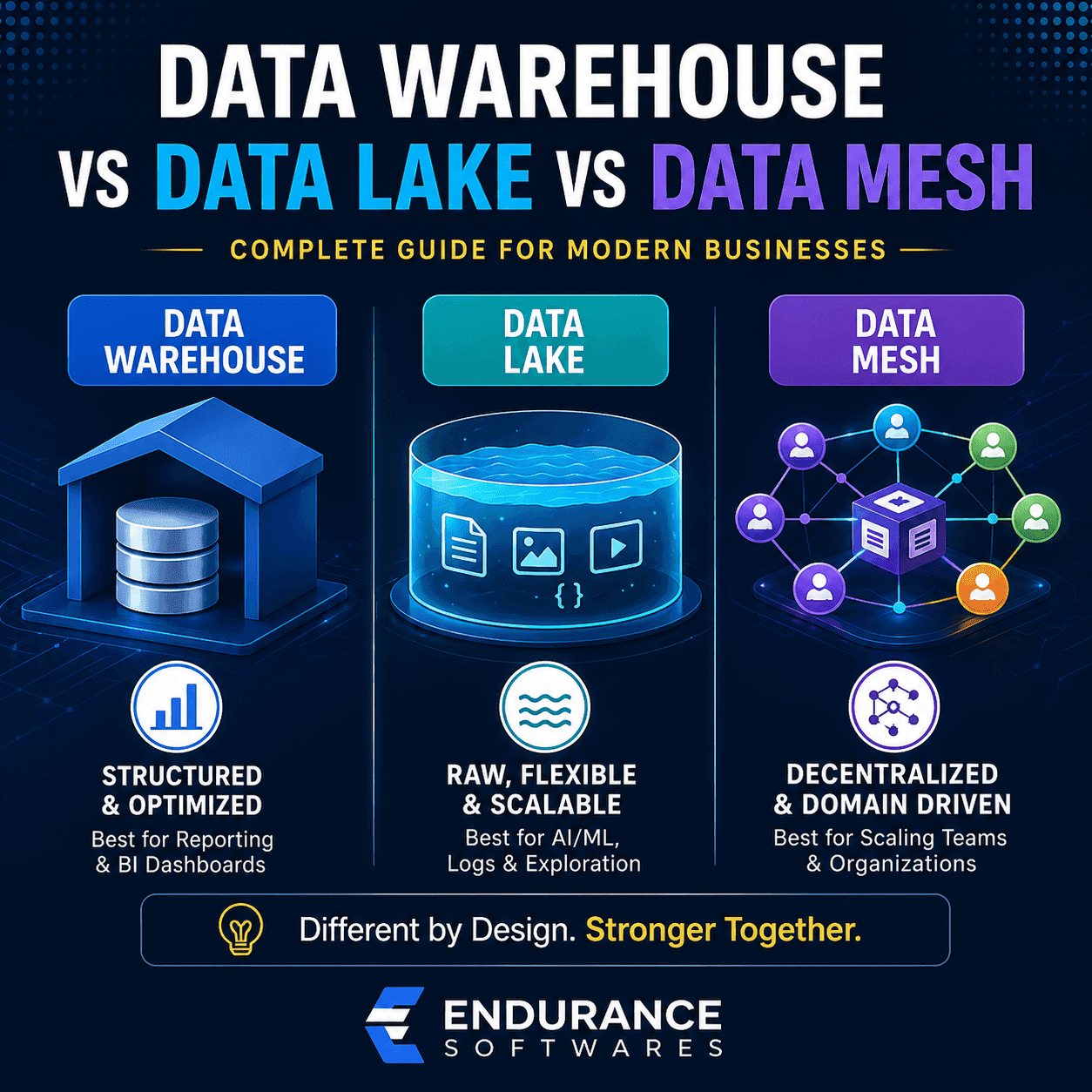
Data Warehouse: best for structured analytics and BI.
Data Lake: best for raw data at scale and ML experimentation.
Data Mesh: best for scaling ownership across multiple teams.
- Data Type: Warehouse (structured), Lake (all types), Mesh (any)
- Storage: Warehouse (yes), Lake (yes), Mesh (no, architecture model)
- Schema: Warehouse (schema-on-write), Lake (schema-on-read), Mesh (flexible)
- Ownership: Warehouse/Lake (centralized), Mesh (decentralized)
- Performance: Warehouse (high analytics), Lake (medium), Mesh (depends)
- Scalability: Warehouse (medium), Lake (very high), Mesh (very high)
- Complexity: Warehouse (medium), Lake (medium), Mesh (high)
How Modern Data Architecture Works (Real-World Setup)
At Endurance Softwares, we rarely implement just one approach. We design hybrid architectures where each layer has a clear role.
Typical Data Flow
- Data Ingestion: APIs, applications, IoT, and logs
- Data Lake: raw data stored in systems like Amazon S3
- Processing Layer: ETL/ELT pipelines clean and transform data
- Data Warehouse: structured data stored in Snowflake or BigQuery
- BI and Analytics: dashboards, reports, and operational insights
- Data Mesh Layer (Optional): domain ownership and governance at scale
When Should You Use What?
Choose Data Warehouse if:
- You need fast reporting
- Your data is mostly structured
- You want quick business insights
Choose Data Lake if:
- You deal with large-scale raw data
- You are building AI/ML systems
- You need flexibility
Choose Data Mesh if:
- Your organization is scaling fast
- Multiple teams need autonomy
- Your centralized data team has become a bottleneck
Real-World Example (SaaS Platform)
Let's say you are building a SaaS product like TrackLabs or a fintech platform.
- Application logs are stored in a Data Lake
- Cleaned customer and transaction data is stored in a Data Warehouse
- Marketing team owns campaign data using a Data Mesh operating model
Result: scalable, flexible, and high-performance data systems.
Common Mistakes Companies Make
Treating Data Lake as a Warehouse
Leads to messy, unusable data and weak trust in analytics.
Over-engineering with Data Mesh too early
Can slow down startups before product-market fit and team maturity.
Ignoring governance
Data quality drops and decision-making becomes unreliable.
Expert Insight from Endurance Softwares
From our experience building SaaS and enterprise systems, the goal is not to choose between Data Lake, Data Warehouse, or Data Mesh. The goal is to design a system where each plays its role efficiently.
Final Thoughts
- Data Warehouse: structured insights
- Data Lake: raw scalability
- Data Mesh: organizational scalability
The future of data is not about tools. It is about architecture, ownership, and execution.