


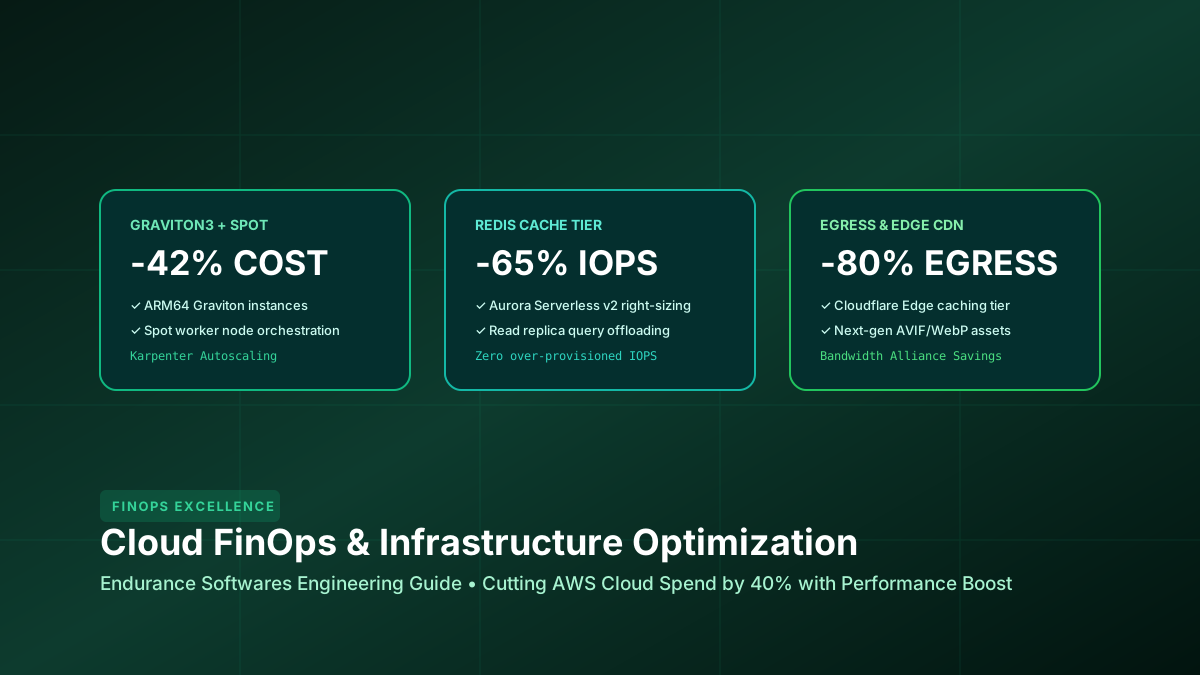
True FinOps is not about starving engineering teams of resources; it is about eliminating structural architectural waste. By migrating compute workloads to ARM64 Graviton instances, dynamically packing containers onto spot instances with Karpenter, and inserting high-hit-ratio Redis caching layers, enterprises save millions annually without a single millisecond of latency degradation.
The 4-Pillar Architectural FinOps Framework
| Infrastructure Tier | Common Source of Waste | Endurance Softwares Optimization Solution | Typical Savings |
|---|---|---|---|
| Compute & Containers | Static x86 on-demand instances running at 15% CPU | ARM64 Graviton3 migration + Karpenter auto-scaling Spot nodes | 40%–60% |
| Relational Database | Over-provisioned IOPS & unindexed queries hitting disk | Composite index tuning + Redis Cache-Aside + Read replicas | 45%–70% |
| Data Storage | Terabytes of cold logs in S3 Standard storage tier | Automated S3 Intelligent-Tiering & Glacier lifecycle policies | 50%–80% |
| Network Egress | Serving raw assets directly from AWS origin servers | Edge CDN caching (Cloudflare / Fastly) & AVIF compression | 75%–90% |
AWS Graviton3 ARM64 Migration
AWS Graviton3 processors offer up to 25% higher compute performance and 20% lower cost compared to equivalent x86 (Intel/AMD) instances. Because Node.js, Go, Python, and Java run natively on Linux ARM64, rebuilding Docker containers for linux/arm64 delivers instant bottom-line savings on Day 1.
Container Packing with Kubernetes Karpenter
Legacy Kubernetes Cluster Autoscalers launch rigid node groups. Karpenter evaluates incoming pod resource requirements in real time and provisions the exact cheapest combination of spot and on-demand instances, automatically bin-packing containers to maintain 85%+ hardware utilization.
PostgreSQL & Database IOPS Right-Sizing
AWS Aurora charges for I/O operations. An unindexed query that runs a sequential table scan on 10 million rows generates hundreds of thousands of billable I/O reads. By running pg_stat_statementsaudits, our database architects eliminate full table scans, reducing Aurora monthly bills by thousands of dollars.
Eliminating Bandwidth Egress Tax
AWS charges up to $0.09 per gigabyte of internet egress. By placing Cloudflare or CloudFront in front of API backends with aggressive cache-control headers, 90% of requests are served from the edge without triggering AWS egress fees.
FinOps Action Checklist
✓ All Docker container images built multi-arch for ARM64 Graviton
✓ Kubernetes Karpenter configured with Spot instance interruption handlers
✓ Aurora IOPS audited via pg_stat_statements to eliminate slow queries
✓ S3 Intelligent-Tiering enabled on all enterprise asset buckets
✓ Cloudflare / CloudFront edge caching shields backend from egress fees
✓ Unattached EBS volumes and idle Elastic IPs automatically pruned
✓ Cost allocation tags enforced on 100% of Terraform resources
✓ Real-time Slack alerts configured for unexpected cloud spend spikes
Cut Your Cloud Spend with Endurance Softwares
Our certified cloud architects perform comprehensive FinOps audits and implement automated infrastructure cost reduction programs.
Request a Cloud FinOps AuditFrequently Asked Questions
How safe is using Spot instances in production?
With Karpenter and AWS Node Termination Handler, your cluster receives a 2-minute advance notice before a spot instance is reclaimed, gracefully draining pods to alternative nodes without dropping user traffic.
Does Graviton require rewriting application code?
No! For modern languages (Node.js, TypeScript, Go, Python, Java, Rust), only the Docker build target needs to specify --platform linux/arm64.
How quickly can we see cost savings?
Most clients see an immediate 20% to 30% reduction in their cloud invoice within the first 14 days of our FinOps pod engagement.