


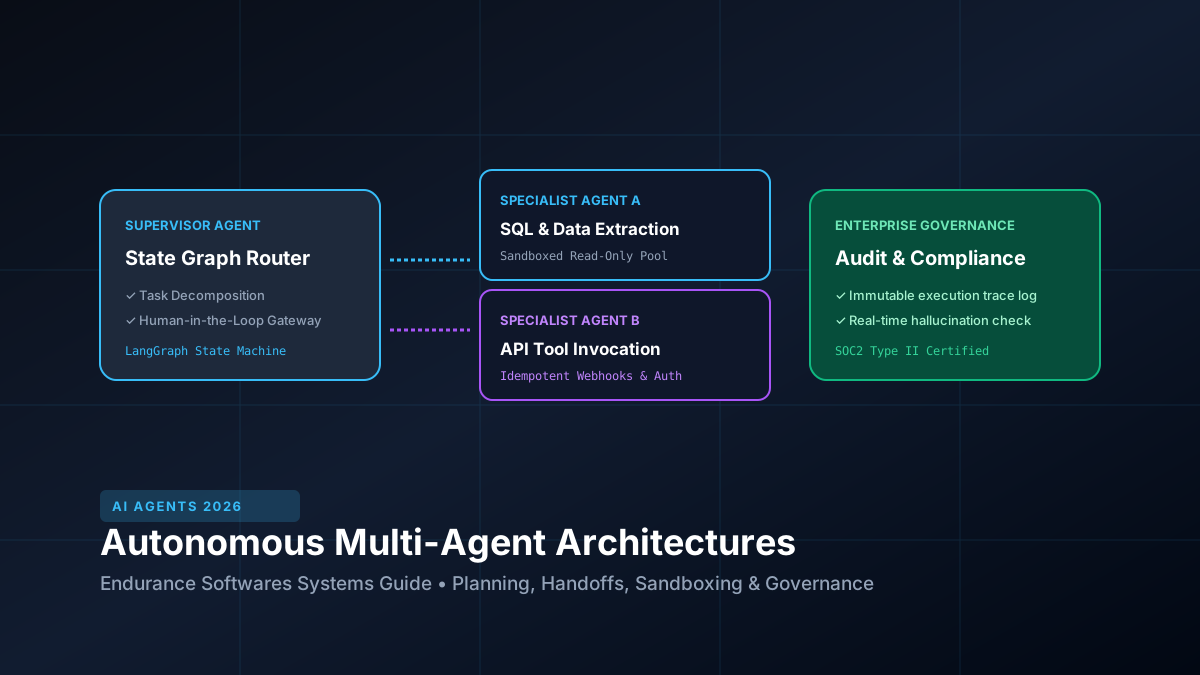
Multi-agent architectures divide and conquer complex business logic. Instead of giving one model every tool in the enterprise, specialized agents (Research Agent, SQL Analyst Agent, Billing Validator Agent) execute focused tasks within isolated memory boundaries, returning structured typed outputs to a supervisor node.
Single Monolithic Prompts vs Multi-Agent Swarms
| Dimension | Single Monolithic LLM Call | Multi-Agent Swarm (Endurance Pattern) |
|---|---|---|
| Context Window Degradation | Massive 100k+ token prompt degrades reasoning | Each agent receives only the relevant < 4k context |
| Tool Collision | Model confused by 40+ mixed function tools | Each specialist agent has 2–3 precise domain tools |
| Failure Recovery | Entire prompt fails on a single hallucination | Supervisor catches sub-agent failure and triggers retry |
| Auditability | Opaque black-box generation | Granular step-by-step state machine execution trail |
The Hierarchical Supervisor-Worker Architecture
A central Supervisor Agent evaluates the incoming customer goal, decomposes it into an ordered sequence of tasks, and dispatches sub-tasks to specialist workers:
- Data Retrieval Agent: Queries enterprise vector stores, Elasticsearch, and structured SQL tables using read-only service accounts.
- Calculation Agent: Executes exact Python calculations in isolated sandboxes rather than relying on LLM mental math.
- Verification Agent: Evaluates the synthesized draft against corporate compliance policies and PII redaction rules before finalizing output.
Sandboxed Tool Execution in Secure MicroVMs
Never allow an AI agent to execute generated Python or bash commands directly on your application server. Endurance Softwares runs untrusted agent code inside ephemeral Linux MicroVMs (using Firecracker or E2B), strictly isolated from production VPC networks with tight memory and 10-second timeout boundaries.
Human-in-the-Loop (HITL) Gatekeeping
Autonomous agents can draft emails, summarize documents, and prepare invoices automatically. However, actions with financial or legal consequences (e.g. initiating a $10,000 refund or deleting a database record) must trigger an asynchronous state pause that waits for explicit human manager approval in Slack or a dedicated web dashboard.
Enterprise Governance & OpenTelemetry Tracing
Every agent message, tool invocation, token cost, and intermediate thought step is recorded as an immutable OpenTelemetry trace sent to centralized monitoring tools (Langfuse / Datadog), providing full regulatory audit trails for SOC2 and ISO27001 compliance.
Multi-Agent System Checklist
✓ Hierarchical supervisor model separates planning from execution
✓ LangGraph state graph ensures deterministic state transitions
✓ Code execution sandboxed in secure MicroVM containers
✓ Human-in-the-loop gates protect high-risk financial actions
✓ Strict token limits prevent infinite agent loops
✓ OpenTelemetry spans record every tool input and output
✓ Automated unit tests validate individual specialist agents
✓ Fallback recovery strategies handle tool API timeouts
Deploy Enterprise AI Agents with Endurance Softwares
We architect and deploy scalable, compliant, and reliable autonomous multi-agent systems that automate complex enterprise business processes.
Consult With Our Multi-Agent ArchitectsFrequently Asked Questions
How do multi-agent systems prevent infinite loops?
We enforce a hard maximum iteration limit (e.g. 10 steps) in the state graph. If an agent does not converge within budget, the supervisor halts execution and escalates to a human operator.
What frameworks are best for multi-agent workflows in 2026?
LangGraph and Temporal are the industry standards for production systems because they provide durable, fault-tolerant state machines with native persistence and human-in-the-loop pausing.
Can agents communicate with our existing enterprise REST APIs?
Yes! We convert your OpenAPI / Swagger specifications into structured typed agent tools with OAuth2 authentication and automated rate-limiting.