


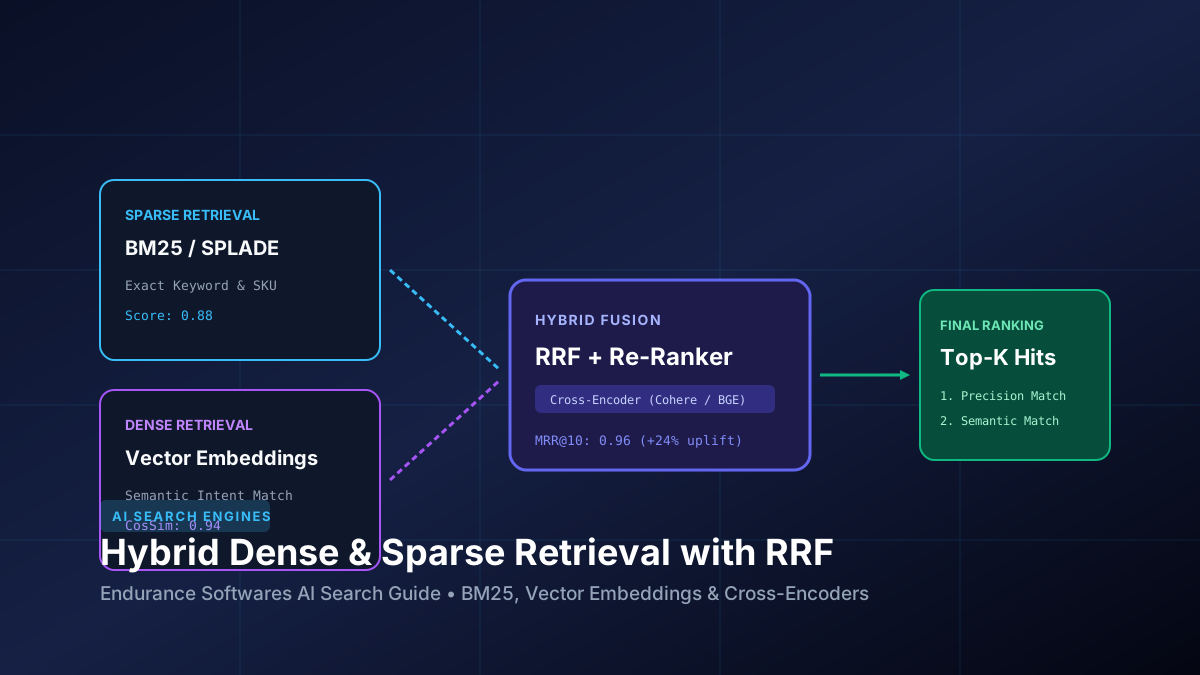
Dense embeddings capture conceptual meaning ("how do I reset my credentials" → "password recovery tutorial"), while sparse lexical indices excel at exact matches ("SKU-99482-X" or "error code 504.11"). Fusing both result sets with Reciprocal Rank Fusion boosts Mean Reciprocal Rank (MRR@10) by up to 28% compared to vector search alone.
Why Pure Vector Embeddings Fall Short
| Search Strategy | Strengths | Failure Modes |
|---|---|---|
| Dense Vectors (OpenAI / Voyage) | Semantic synonyms, multilingual alignment, natural language intent | Out-of-vocabulary terms, part numbers, exact acronyms, rare names |
| Sparse Lexical (BM25 / OpenSearch) | Exact string match, typo tolerance, low indexing cost, instant updates | Vocabulary mismatch problem; misses synonyms completely |
| Hybrid RRF + Re-Ranker | Best of both worlds; perfect exact matches + deep semantic understanding | Requires 2-stage retrieval pipeline (~40ms additional latency) |
The 2-Stage Hybrid Search Pipeline
Implementing Reciprocal Rank Fusion in TypeScript
RRF normalizes and merges rank positions without needing to calibrate raw disparate score ranges:
// hybrid-search.ts - Reciprocal Rank Fusion (RRF) with Sparse & Dense Retrieval
interface SearchResult {
  id: string;
  score?: number;
  document: string;
}

export function reciprocalRankFusion(
  sparseResults: SearchResult[], // e.g., BM25 or SPLADE
  denseResults: SearchResult[],  // e.g., OpenAI / Voyage embeddings
  k: number = 60 // RRF smoothing constant
): SearchResult[] {
  const rrfScores = new Map<string, { score: number; doc: string }>();

  // Accumulate sparse reciprocal rank
  sparseResults.forEach((item, rank) => {
    const existing = rrfScores.get(item.id) || { score: 0, doc: item.document };
    existing.score += 1.0 / (k + rank + 1);
    rrfScores.set(item.id, existing);
  });

  // Accumulate dense reciprocal rank
  denseResults.forEach((item, rank) => {
    const existing = rrfScores.get(item.id) || { score: 0, doc: item.document };
    existing.score += 1.0 / (k + rank + 1);
    rrfScores.set(item.id, existing);
  });

  // Sort by fused reciprocal rank score
  return Array.from(rrfScores.entries())
    .map(([id, data]) => ({
      id,
      document: data.doc,
      score: data.score,
    }))
    .sort((a, b) => (b.score ?? 0) - (a.score ?? 0));
}
Cross-Encoder Neural Re-Ranking
While bi-encoder embeddings process query and document independently to allow fast vector indexing, cross-encoders evaluate the query and candidate documents simultaneously via full multi-head self-attention. Applying a cross-encoder to the top 25 candidates yields state-of-the-art precision:
// cohere-rerank.ts - Cross-Encoder Neural Re-Ranking
import { CohereClient } from "cohere-ai";

const cohere = new CohereClient({ token: process.env.COHERE_API_KEY });

export async function reRankSearchResults(
  query: string,
  candidateDocs: Array<{ id: string; text: string }>,
  topN: number = 5
) {
  const response = await cohere.v2.rerank({
    model: "rerank-v3.5",
    query: query,
    documents: candidateDocs.map((d) => d.text),
    topN: topN,
    returnDocuments: false,
  });

  return response.results.map((result) => ({
    id: candidateDocs[result.index].id,
    text: candidateDocs[result.index].text,
    relevanceScore: result.relevanceScore,
  }));
}
Relevance Metrics: Evaluating Search Accuracy
Never tune search parameters on intuition alone. Track industry-standard ranking metrics:
- NDCG@10 (Normalized Discounted Cumulative Gain): Measures graded relevance quality across top 10 positions.
- MRR@10 (Mean Reciprocal Rank): Tracks how frequently the first correct answer appears in the #1 or #2 spot.
- Zero-Result Query Rate: Percentage of user queries that returned zero hits (target < 2%).
Enterprise Search Checklist
✓ Hybrid search combines BM25 full-text index with dense vector embeddings
✓ Reciprocal Rank Fusion (RRF constant k=60) merges disparate scores
✓ Neural cross-encoder (Cohere / BGE) re-ranks the top 25 candidates
✓ Exact part numbers and SKUs indexed with keyword analyzers
✓ P95 retrieval latency kept below 80ms through parallel execution
✓ Semantic query cache in Redis reduces repeat vector compute
✓ Automated evaluation harness monitors NDCG@10 on golden queries
✓ Synonyms dictionary and token lemmatization tuned for domain terminology
Build Intelligent Search Systems with Endurance Softwares
Our AI engineering team designs production hybrid search engines, knowledge retrieval systems, and enterprise RAG platforms.
Consult With Our Search EngineersFrequently Asked Questions
What value of 'k' is best for Reciprocal Rank Fusion?
A smoothing constant of $k = 60$ is the standard empirical default proposed in academic literature, preventing outlier high ranks from dominating the fused score.
How much latency does a neural re-ranker add?
Re-ranking the top 20 documents typically takes 15ms to 35ms using lightweight quantized models or cloud APIs like Cohere Rerank.
Can PostgreSQL do hybrid search natively?
Yes! PostgreSQL can execute to_tsvector (Full-Text Search) and pgvector in a single SQL query, merging the results using RRF directly inside a Common Table Expression (CTE).