


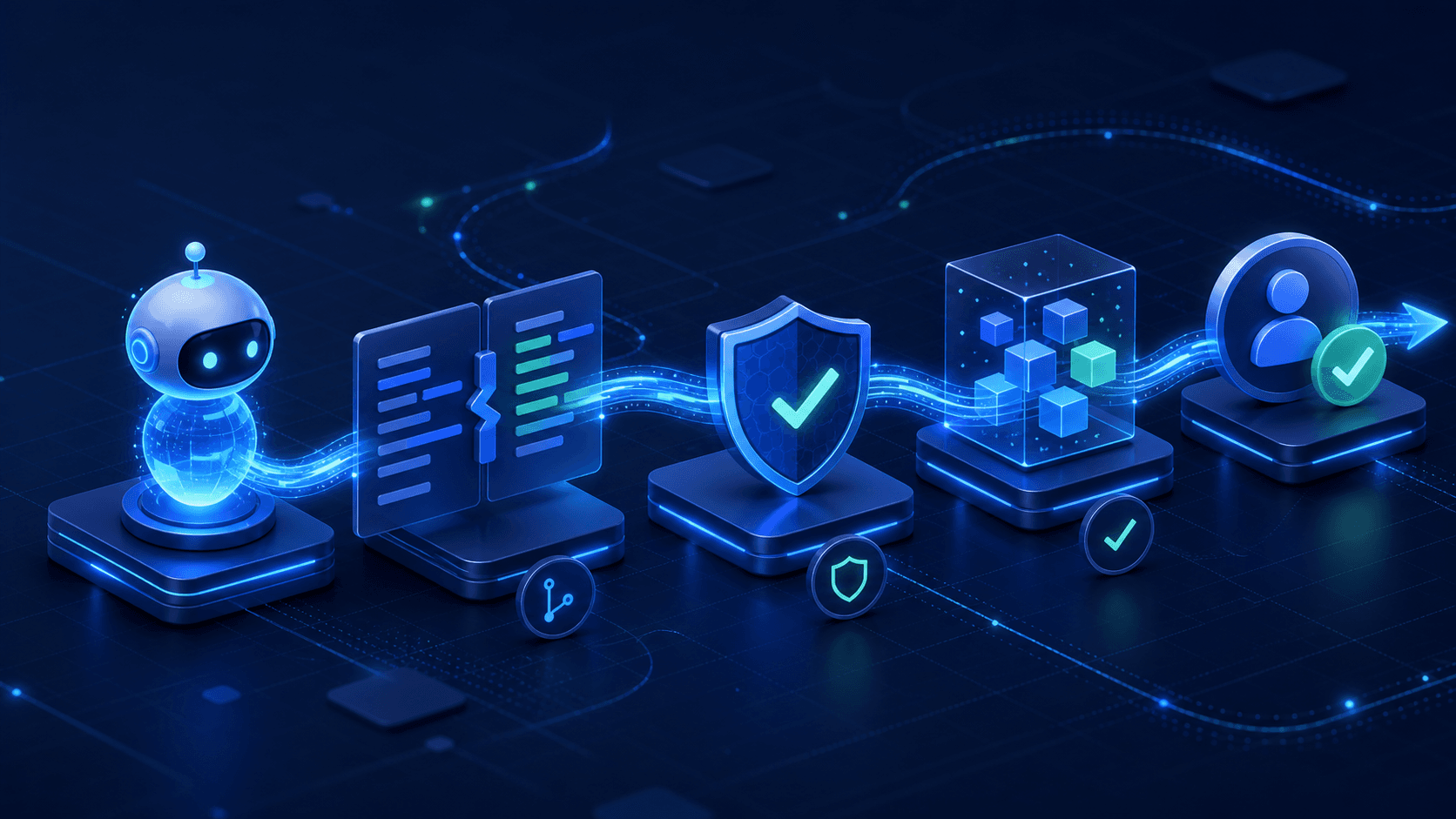
Give the agent a narrow, reversible job
An AI coding agent is most useful when it receives a concrete outcome, a bounded part of the repository, and an explicit definition of done. “Improve the app” is not an operational task; “add validation to this request handler, update its tests, and do not change the API contract” is. Small scopes make the generated diff easier to understand, test, and roll back.
Limit access
Grant only the repository, directories, tools, and credentials needed for the task. Keep production secrets and broad cloud permissions outside the agent session.
Define invariants
State what must not change: public contracts, migrations, billing paths, accessibility behavior, or deployment configuration.
Require a plan
Ask for the files affected, assumptions, test approach, and rollback path before an agent makes a multi-file change.
Start with work that has a strong local feedback loop: test additions, narrowly defined refactors, documentation updates, or isolated UI improvements. Avoid handing an agent irreversible data changes, permission-model rewrites, or incident response without a prepared, human-led runbook.
Put the agent inside a controlled delivery workflow
Reliable teams do not let an agent write directly to the default branch or deploy from a conversational answer. Give it a disposable branch or sandbox, then make every generated change travel through the same pull-request controls used by the rest of the team.
task brief → isolated branch → generated diff → lint and tests → security checks → human review → staged release → metrics and rollback decisionUse protected branches, required status checks, code owners, and an approval policy that matches the system’s risk. Separate the identity that creates a change from the identity that approves or deploys it. This prevents a prompt injection, compromised integration, or mistaken instruction from becoming a single-step production incident.
For web changes, make the review environment useful: include before-and-after screenshots, test data that contains no customer information, and an explicit preview URL. For a Next.js app, pair the generated diff with the performance and user-impact checks in our Next.js Core Web Vitals guide so faster authoring does not hide a slower experience.
Make verification deterministic wherever possible
A fluent explanation is not evidence that a change works. Ask the agent to run the smallest relevant automated checks, report the exact commands and results, and call out what it could not verify. Then use deterministic gates to evaluate the diff independently of the model’s confidence.
- Run linting, type checks, unit tests, and focused integration tests for the changed behavior.
- Scan added dependencies and lockfile changes; prefer existing, approved packages where possible.
- Check authentication, authorization, input validation, logging, and error paths on any changed endpoint.
- Review schema changes for lock time, backwards compatibility, and a tested rollback.
- Require a human to read the diff, especially generated configuration, shell commands, and permission changes.
Keep prompts, tool calls, changed files, test output, and reviewer decisions with the pull request. That audit trail makes a surprising behavior debuggable and turns recurring requests into better templates. When agents touch APIs, use the contract and deprecation practices in our Node.js API versioning guide to avoid accidental breaking changes.
Measure outcomes, then expand autonomy slowly
Track whether agent-assisted work improves lead time, review time, escaped defects, rollback rate, and developer satisfaction. Measure by task type rather than averaging every use case together. An agent may excel at test scaffolding and be poor at cross-service changes; your policy should reflect that difference.
Begin with a small cohort and a short list of allowed task classes. Sample completed changes for quality, document failure modes, and update repository guidance when reviewers spot predictable mistakes. Increase the scope only after the existing gates catch the failures you expect. Observability matters here too: use structured logs, deployment annotations, and release comparisons so an issue can be tied back to a specific change. Our Next.js observability guide explains the production signals that make that investigation faster.
AI coding agent production checklist
✓ Scope each task to a clear, reversible outcome
✓ Use least-privilege repositories, tools, and credentials
✓ State invariants and prohibited areas before work starts
✓ Keep generated changes on protected pull-request workflows
✓ Run independent lint, test, and security gates
✓ Review dependencies, permissions, and configuration manually
✓ Preserve prompts, diffs, test evidence, and approvals
✓ Expand autonomy only when measured outcomes support it
Build AI-assisted delivery you can trust
Endurance Softwares helps teams apply AI development practices without sacrificing secure architecture, reliable releases, or maintainable software ownership.